How many houses can be built on a 5,000 m² plot?
- What article 55 says, in its own words
- The real dividing line: housing for the property or a development for third parties
- Why the land's designated use governs everything else
- What to watch in a two house project
- The routes that do exist, depending on what you want to achieve
- What happens if you build anyway, without a permit
- The mistake of buying jointly without resolving this first
- Frequently asked questions
- ↳ Can I subdivide my 5,000 metre plot into two of 2,500?
- ↳ So how many houses can I build?
- ↳ Can I install two independent meters?
- ↳ We bought as shares and rights. Does that change anything?
- ↳ Is there a maximum size for the caretaker's house?
- ↳ Can I build first and regularise later?
- ↳ What if, instead of a second house, I extend the first one?
- How we handle it
Quick answer: the law does not set a number of houses. It sets a purpose. Article 55 of the General Urban Planning and Construction Act prohibits putting up buildings outside the urban boundary, with some exceptions, and one of them is housing for the owner of the property and their workers, in the plural. That is why the right question is not how many houses fit, but who they serve and whether the group of buildings reads as working the property or as a disguised condominium. One house for the owner and another for whoever looks after the property fit the exception. Two identical houses for two families who bought jointly look more like a small housing development, and that is where the exception is called into question.
The plan sounds reasonable: two siblings buying a 5,000 metre plot together, or one of them buying it and putting up a house for their parents at the back of the property. The costs are split and everyone wins. The problem shows up at the Municipal Building Department, when it is time to apply for the permit.
What article 55 says, in its own words
Let us start by correcting a widely repeated idea. People often say that only one house can be built on a plot. That is not what the law says.
Article 55 of the General Urban Planning and Construction Act establishes that outside urban boundaries it is not permitted to open streets, subdivide to form settlements or put up buildings. That is the rule. The first paragraph sets out three direct exceptions, shown in this table. The final paragraph also allows industrial, infrastructure, facilities, tourism and settlement buildings, but only with prior favourable reports from the regional office of the Ministry of Housing and from the SAG.
Which is why the honest answer to how many houses can be built is not a number. The law does not give one. What it gives is a purpose, and the permit turns on whether the project fits that purpose.
One important caveat: if the property lies in an area covered by an intercommunal or metropolitan zoning plan, that plan can set land uses for rural areas for the purposes of article 55, under article 2.1.7 of the General Ordinance. That is why the first step is the municipality's certificate of prior information, which states which plan governs the property.
The real dividing line: housing for the property or a development for third parties
This is the criterion that decides the outcome at the counter.
Circular DDU 455 of the Ministry of Housing and Urban Planning, dated 18 January 2021, clarified that buildings needed for farming the property and housing for the owner and their workers do not require a favourable report from the Servicio Agrícola y Ganadero (the Agriculture and Livestock Service, or SAG) or from the regional office of the Ministry of Housing, and are not subject to the obligations in the first paragraph of article 2.2.4 bis of the General Ordinance. The permit goes straight to the Municipal Building Department.
But the exception covers what the law names: the home of whoever owns the property and those of the people who work on it. When what goes up is housing for third parties, it is no longer that exception. The same article 55 requires, for settlements outside the urban boundary, favourable reports from the regional office of the Ministry of Housing and from the SAG before the permit is granted, and it tasks the regional office with ensuring that subdivisions and buildings for non agricultural purposes do not create new urban settlements outside planning. In other words, the distinction is not between one house and two houses: it is between the housing the property needs and a housing development.
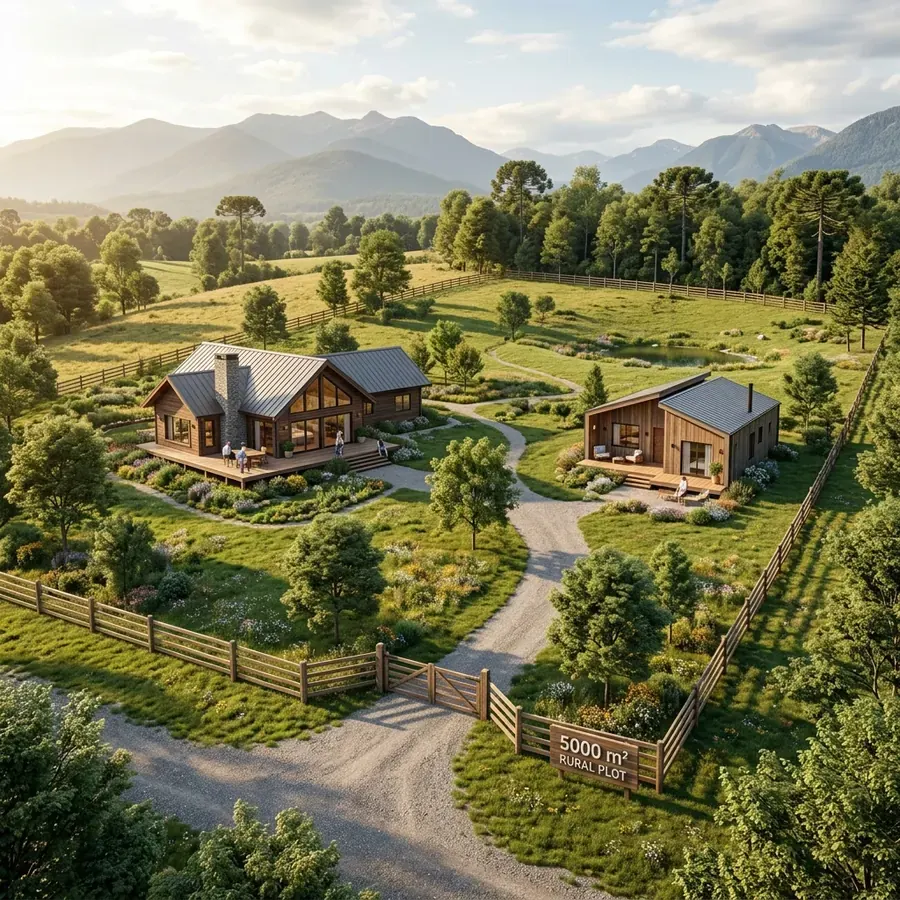
In practice. A main house plus a home for whoever looks after or works the property fits the exception and goes straight to the Municipal Building Department. Two equivalent houses for two families, with separate access, independent meters and an internal boundary, look more like a small housing development than the owner's home, and that is where the exception gets disputed.
One case shows how far that dispute can go. In a rural plot development in Panguipulli, the Regional Comptroller's Office of Los Ríos concluded that the article 55 exception did not apply to thirteen building permits and that they had been granted without the favourable reports of the SAG and the regional office of the Ministry of Housing. The Court of Appeals of Valdivia rejected the developer's constitutional protection action, and the Supreme Court upheld that ruling on 5 October 2020, in case No. 62.948 of 2020.
Why the land's designated use governs everything else
A 5,000 metre plot is not a residential lot. It is rural land suited to agricultural, livestock or forestry use. Decree law 3.516 leaves the lots resulting from a subdivision subject to the prohibition on changing their use under articles 55 and 56 of the General Urban Planning and Construction Act, and article 55 tasks the regional office of the Ministry of Housing with ensuring that subdivisions and buildings for non agricultural purposes do not create new urban settlements outside intercommunal planning.
That is why the same design can be approved or rejected depending on what the file shows. If the two houses are presented as part of working the property, one reading applies. If the layout has the geometry, access points and infrastructure of a small condominium, another reading applies, and it matches what the SAG looks at when it reviews subdivisions, a subject we cover in why the Service rejects subdivisions.
What to watch in a two house project
- Hierarchy between the buildings. The worker's home should read as such: its size, finishes and layout need to match. Two houses of equal size and standard contradict that story.
- One property. Both homes sit on the same property and under the same property tax roll number, and neither can be sold separately until the property is lawfully divided. Subdividing under 5,000 metres is only possible under a legal exception.
- Access and infrastructure. Two independent entrances from the public road, with an internal fence separating the two houses, is a clear sign of two self contained units.
- Utilities. A second connection or a second meter does not turn the second house into a separate property: the property is still a single one. And duplicated utilities are, precisely, another sign of two self contained units.
- Consistency with what is already built. If the property has no productive buildings at all and does have two houses, the agricultural purpose is left unsupported.
Does this match your situation?
Ask about my case on WhatsAppThe routes that do exist, depending on what you want to achieve
What happens if you build anyway, without a permit
This is the most expensive path, and the consequences cascade.
- Without a permit there is no final municipal approval, and without it the law prohibits living in or using the building, under article 145 of the General Urban Planning and Construction Act. The ley del mono does not work for what is built today: it requires the building to predate 4 February 2016, and even the bill before the Senate that would extend it would only cover buildings completed before 28 November 2025. Anything built now without a permit will have to be regularised through the ordinary route, meeting every rule, including the article 55 exception.
- Fines and possible demolition. The Municipal Building Department can report the infringement to the Local Police Court, and the mayor, at the Department's request, can order the demolition of works carried out in breach of the Act or the Ordinance, under article 148. How much you risk and how to defend against that fine is covered in Municipal Building Department fines for building without a permit.
- The property becomes hard to finance. A second home without a permit or final approval complicates the valuation and the mortgage of anyone who wants to buy, as we explain in selling a house without final municipal approval.
- The family conflict gets registered. If two people built on a single roll number, neither can sell their house separately. It is a single property, and any of the co owners can request partition of the whole property, unless they agreed not to divide it, an agreement that cannot exceed five years.
The mistake of buying jointly without resolving this first
It is worth pausing on this case, because the damage is not a planning issue but a financial one.
Two people buy a plot and each builds their own house. On paper, they are co owners of the whole property, not owners of their own house. Each can sell or mortgage their share in the property, but not the house they built as a separate property, and if one of them dies their heirs enter the co ownership. And if one of them requests partition, since the property cannot be divided into two lots under 5,000 metres, the partition judge awards it to whichever co owner bids the most, and any of them can ask for outside bidders to be admitted, which means an auction.
The house you built does not guarantee that you keep it. At most, you can ask in the partition for the improvements you made to be recognised, and how much is recognised depends on the evidence and the valuation: there is no guarantee of recovering everything you invested. That is why the correct order is the opposite of how it is usually done: first you establish whether the property allows two separate properties, and only then do you buy.
If you are wondering whether the rules for rural plots are about to change, read what Chile's rural subdivision bill would change.
Frequently asked questions
Can I subdivide my 5,000 metre plot into two of 2,500?
Not through the ordinary route. The minimum under decree law 3.516 is 5,000 metres per lot, and it does not allow an exception by agreement between the parties. The only way to go below that area is a legal exception, and the best known one, the ley Sabag, does not split the property into two halves either: it allows a lot of between 500 and 1,000 metres to be separated for a one time transfer to a first degree ascendant or descendant, and it does not apply if the property originated in a subdivision under decree law 3.516, as many 5,000 metre plots did. The rest are set out in the exceptions for subdividing below half a hectare.
So how many houses can I build?
As many as correspond to the housing of the owner and of their workers, based on the actual use of the property. There is no figure in the law. What there is, is a functional limit: once the homes stop being those of the owner and their workers and become a development for third parties, they fall outside the exception and into what article 55 treats as a settlement, which requires prior favourable reports.
Can I install two independent meters?
The requirements for a connection or a meter depend on electricity regulations and the distribution company, not on the Municipal Building Department. But even if you get one, a second meter does not create a separate property or regularise anything: the property is still a single one, and two meters and two entrances are precisely signs of two self contained units.
We bought as shares and rights. Does that change anything?
Not necessarily. Buying fifty percent of the property does not by itself entitle you to a second main house, because the restriction is a planning one and does not depend on how many owners are named in the title. And in financial terms the situation is worse, not better: we cover that in the guide to shares and rights in an undivided estate.
Is there a maximum size for the caretaker's house?
The law does not set a size in metres. What gets assessed is consistency: a worker's home with the size and standard of a main house contradicts its own classification. The proportion between the two buildings may be one of the factors that gets reviewed.
Can I build first and regularise later?
It is the most expensive gamble. The ley del mono does not reach what is built today, so regularisation would have to go through the ordinary route, which requires the building to be one that could be authorised on that land. If the second home does not fit the exception, no procedure will make it legal, and in the meantime it cannot lawfully be lived in.
What if, instead of a second house, I extend the first one?
It is a real alternative and often the simplest one, as long as the result is still a single home and not two self contained units in disguise. An extension with its own kitchen, access and utilities is, in effect, a second home, and gets assessed as one.
How we handle it
The first step is a feasibility review before the first stone is laid: what the municipality's certificate of prior information says, what use the land is designated for, what area the property actually has, and whether it can accommodate a second unit. That tells you whether the project should go through the article 55 exception, the ley Sabag, or a formal subdivision.
Next comes designing the file, which is where the permit is won or lost: the hierarchy between the buildings, the access points, the justification for the property's use and the submission to the Municipal Building Department. Our own team of surveyors and architects does the survey and the plans, so the project and the legal file are put together at the same time, not in separate offices.
If the purchase is between two or more people, before signing it is worth looking at the title study and putting in writing what happens if the property later cannot be divided. And if the problem already exists, with an unpermitted building or a co ownership at a standstill, there is regularisation of title and the civil litigation route, depending on the case.
Send us the property's roll number and tell us what you want to build and for whom. With that, we can tell you whether your case falls within the exception, what can be submitted, and what is worth changing before you spend money on plans.
Tell us your situation and we will tell you what applies.
Talk to a lawyer on WhatsApp