Where is the ley Sabag processed? Agencies, steps and documents
- Summary: Where is this procedure carried out?
- What does not appear in the route: neither the SAG nor authorised third parties
- The procedure step by step
- Details of the agencies and documents required
- ↳ 1. Qualified professional (drawing up the plan)
- ↳ 2. Notary in the relevant municipality
- ↳ 3. Municipal Building Department (urban property only)
- ↳ 4. Servicio de Impuestos Internos (the Chilean tax authority)
- ↳ 5. Conservador de Bienes Raíces (CBR)
- Stages, agencies and documents
- Common mistakes that delay the process
- ↳ Do you meet the prior requirements?
- The order matters: why you cannot skip a stop
- Where most files fall apart
- Frequently Asked Questions (FAQ)
- ↳ Does the ley Sabag need approval from the SAG or from an authorised third party?
- ↳ Does the process change if the property is urban rather than rural?
- ↳ How long does the ley Sabag process take?
- ↳ Can I do this without a lawyer?
- How we handle this
This article covers a specific aspect of the ley Sabag. If you are looking for the full picture, check our complete guide to the ley Sabag, with requirements, a step by step and costs.
Summary: Where is this procedure carried out?
The ley Sabag is not processed at a single office, but it does not go through where most people think either. If the property is rural, the route has four stops: a qualified professional draws up the subdivision plan, the transfer deed is signed before a notary, the tax authority (SII) assigns an assessment roll number to the new lot, and the Conservador de Bienes Raíces registers the title. If the property is within the urban limit, a stop is added at the Municipal Building Department and the plan must be signed by an architect.
This article focuses on the institutional route: who does what, and in what order. If you want to first understand the origin of this exception and its two variants, family and institutional, check our guide on the history of the ley Sabag. And if the family relationship or the surface area in your case does not fit this route, there are nine other exceptions for subdividing below 5,000 square metres, which we cover in this guide.
What does not appear in the route: neither the SAG nor authorised third parties
It is worth starting here, because it is the most repeated mistake online, and the one that costs people the most money. There is a widespread idea that a subdivision under the ley Sabag has to go through certification from Servicio Agrícola y Ganadero, the Agriculture and Livestock Service (SAG), and, before that, through review by an authorised third party. That is not the case, and this is not our own interpretation.
Resolución Exenta N° 4788 of 2024 issued by the SAG, in its section V, expressly excluded letter j) of article 1 of DL 3.516, which is the rule behind the ley Sabag, from the certification required under article 46 of Law 18.755. It did so in compliance with dictamen N° E258993 of 2022 from the Contraloría General de la República, the National Comptroller's Office, which established that requiring that certification in this case amounted to imposing a requirement the decree law does not contain. The same resolution repealed Resolución Exenta N° 3904 of 2019, which was the one that had caused the confusion.
The authorised third party does exist, but it belongs to a different procedure: certification of subdivisions of rustic properties into lots of half a hectare or more, where the SAG can rely on external reviewers to check admissibility and technical aspects. That is the general route under DL 3.516, and we explain it in detail in our guide to subdividing agricultural land. The ley Sabag runs on a different track.
The practical consequence is twofold. On one hand, the process is shorter and cheaper than many people budget for. On the other, and this is what usually comes as a surprise, nobody is going to review the file before you sign. There is no agency to tell you the family relationship does not fit, or that the lot came out at 1,040 square metres. The mistake is discovered at the Conservador, once everything up to that point has already been paid for, or worse, years later.
The procedure step by step
This is the flow for a rural property, which is the usual scenario for the ley Sabag:
And this is the flow when the property lies within the urban limit, where the Municipal Building Department is added:
Details of the agencies and documents required
Below we break down each stage with what it actually requires, under DL 3.516 and Law 19.807.
1. Qualified professional (drawing up the plan)
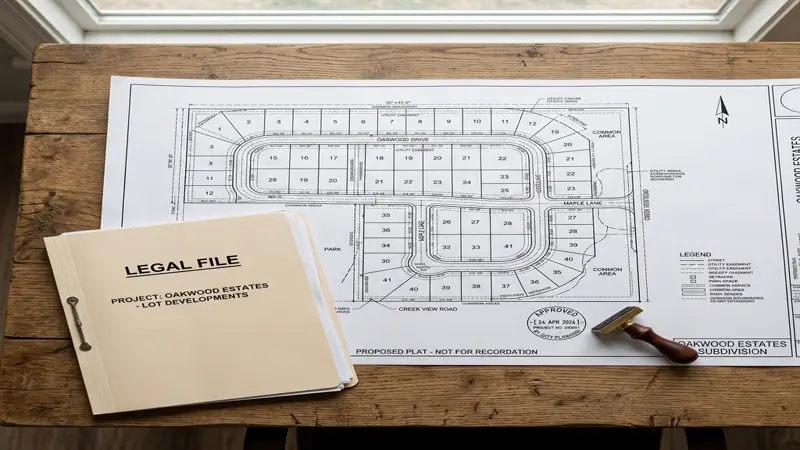
Everything starts with the subdivision plan, prepared by a surveyor or geodetic engineer. If the property is within the urban limit, the plan must be signed by an architect, because the Municipal Building Department will not accept a survey without that responsible signature.
The plan has to identify the lot being separated, with its boundaries, its exact area within the range of 500 to 1,000 square metres, and its access, as well as clearly defining the remainder the owner keeps. It is the document that later gets filed with the Conservador, so any imprecision here carries through to the end.
2. Notary in the relevant municipality
Once the plan is ready, the public transfer deed to the ascendant or descendant is drafted and signed. This is the stage where the outcome is decided, because the deed must expressly record that the transaction relies on letter j) of article 1 of DL 3.516, identify the family relationship, and record the five year prohibition on transfer.
The Civil Registry certificates proving the relationship are also attached here, along with the assessed value certificate for the parent property, which must be below 1,000 unidades de fomento (UF). No official is going to ask for them beforehand: if they are missing or do not match, the problem shows up later.
3. Municipal Building Department (urban property only)
When the land is within the urban limit, the file goes through the municipality's Municipal Building Department (DOM). This is the stage that does not exist in the rural scenario, and the one that most surprises people who came looking for information with a rural property in mind. An urban property is not processed under rural criteria, and a file put together for a rural property stops at the municipality.
4. Servicio de Impuestos Internos (the Chilean tax authority)
The tax authority assigns its own assessment roll number to the lot being separated, so the new property is identified for tax purposes on its own and no longer carries the original property's roll number. Without that roll number the lot has no independent tax existence, which later complicates everything from paying property tax to applying for a utility connection.
5. Conservador de Bienes Raíces (CBR)
The Conservador registers title in the relative's name and files the plan. In the same act it records ex officio the legal prohibition on transferring the lot to an unrelated third party for five years, without anyone having to request it. Only once registration has been carried out is the relative the owner in the eyes of the law, no matter how signed and paid for the deed already is.
Stages, agencies and documents
| Stage | Agency / Entity | Resulting Document |
|---|---|---|
| 1. Topographic survey | Surveyor or architect | Subdivision plan |
| 2. Drafting and signing | Notary | Public deed |
| 3. Municipal review (urban property only) | Municipal Building Department | Approved plan |
| 4. Roll assignment | Tax authority | Assessment roll number for the new lot |
| 5. Title registration | Conservador de Bienes Raíces | Registration and five year prohibition |
Does this match your situation?
Ask about my case on WhatsAppCommon mistakes that delay the process
Because there is no prior administrative review that filters out mistakes, they show up at the end of the road, at the notary's office or straight at the Conservador. The most common ones are these:
- Plans flagged with objections: area tables with calculation errors, a lot that falls outside the range of 500 to 1,000 square metres, boundaries that do not close, or existing rights of way that the survey leaves out.
- Unregularised title on the parent property: inconsistencies in earlier registrations, an unregistered inheritance somewhere in the chain, or missing powers of representation if the person transferring is elderly.
- Poorly documented family relationship: expired or incomplete Civil Registry certificates, or a second degree relationship the family assumed was covered.
- Assessed value above the limit: the parent property must be below 1,000 UF, and that figure is checked at the time of the transaction, not when the idea first came up.
Do you meet the prior requirements?
We have designed a free tool that lets you assess your particular case in under a minute.
The order matters: why you cannot skip a stop
The stops in the process are not a list of tasks that can be handled in parallel. Each one produces the document the next one requires as an entry requirement, which is why jumping ahead a step usually means paying for it twice.
- The plan comes first. Without the subdivision plan prepared by a qualified professional there is nothing to describe in the deed and nothing to file with the Conservador. A sketch, an old plan, or a drawing file without a responsible signature will not work as a starting point.
- The deed has to say what it needs to say. It is not enough to transfer the property: it must record that the transaction relies on the legal exception, and the five year prohibition must be reflected. A deed drafted like any ordinary sale is the most common way of ending up with a contract that cannot later be registered.
- The municipality only comes into play if the property is urban. It is a substantive difference, not a procedural one. Mixing up the rural and urban scenarios means putting together the whole file down the wrong route.
- The tax authority gives the lot its own identity. Assigning the new roll number is what lets the land have a tax existence of its own and, for example, receive a utility connection or apply for a building permit.
- The Conservador closes the circle. Until registration has been carried out, the relative receiving the lot is not the owner in the eyes of the law, however signed and paid for the deed may be.
Where most files fall apart
Rejections are rarely down to the case being unworkable. They come from documentation that does not match up, and almost all of them can be anticipated before signing.
The first is the family relationship. The exception applies only to first degree relatives, and that has to be proven with up to date certificates, not with the parties' own statement. A relationship the family takes for granted may not be properly documented.
The second is a mismatch between the title and the land. If the parent property's registration describes an area or boundaries that do not match what the survey shows, the problem has to be resolved beforehand, by rectifying it, because you cannot precisely transfer a portion of something that is described incorrectly.
The third is the status of the parent property. Mortgages, prohibitions, attachments, or an unregistered inheritance somewhere in the chain block the transfer even if the plan is flawless. Checking the property's registration status is the first thing that should be done, and it is usually the last thing people do.
The practical rule that sums it all up: the file is built backwards. First you check how the property is registered and who actually owns it, then you survey it, and only then do you decide whether the case fits the ley Sabag or not. And since nobody reviews it for you on this route, that prior check is not a luxury, it is the only filter there is.
Frequently Asked Questions (FAQ)
Does the ley Sabag need approval from the SAG or from an authorised third party?
No. Resolución Exenta N° 4788 of 2024 from the SAG, in its section V, expressly excluded letter j) of article 1 of DL 3.516 from the certification required under article 46 of Law 18.755, in compliance with dictamen N° E258993 of 2022 from the Contraloría General de la República. Certification by the SAG and review by authorised third parties apply to subdivisions of half a hectare or more, which are a different procedure. If you are asked for that step to transfer property to a son, daughter or parent, you are being asked for something the rules do not require.
Does the process change if the property is urban rather than rural?
Yes, and it is an important difference. For a rural property the route is professional, notary, tax authority and Conservador. For a property within the urban limit the plan must be signed by an architect and a stage is added at the Municipal Building Department, making the sequence professional, notary, DOM, tax authority and Conservador. Putting the file together with the wrong criteria means redoing it.
How long does the ley Sabag process take?
Between three and six months in a clean case, counting from hiring the surveyor through to registration at the Conservador. Since there is no prior administrative certification, the timeframe depends mostly on the availability of the professional preparing the plan and on the parent property's registration status. If an unregistered inheritance or a discrepancy in the area turns up, the timeframe is set by how long that prior regularisation takes, not by the process itself.
Can I do this without a lawyer?
The law does not require a lawyer's sponsorship. The real issue is different: since no agency reviews the file on this route before you sign, drafting the deed and carrying out the prior title study are the only quality control the process has. That is precisely where the cases that reach our office after signing tend to get stuck.
How we handle this
When someone writes to us who has already signed and the Conservador has raised objections to the deed, the work is different from that of someone who is just about to start. That is why the first review always begins the same way: how the parent property is actually registered today, not how the family believes it is.
We coordinate the four or five stops on this route with our own team of lawyers and surveyors, so the same firm carries out the survey, drafts the deed and manages the registration, without depending on third parties who do not answer for the final result.
The first assessment is free. Send us the property's assessment roll number and the family relationship with whoever will receive the lot, and we will confirm whether your case falls under the rural or urban route, and what documents need to be gathered before hiring the professional who prepares the plan.
Tell us your situation and we will tell you what applies.
Talk to a lawyer on WhatsApp