Buying land in Pucón and Villarrica: indigenous land, the volcano and the lakeshore
- Two Registrars for three districts
- Indigenous land: the first thing to rule out
- The lakeshore: public access and maritime concessions
- The Villarrica volcano and the zoning plans
- Curarrehue and the border zone
- National parks, araucarias and native forest
- Regularized titles and rural plots
- Building in the lake's watershed: permits and septic tanks
- Heritage and archaeological finds
- If you are buying from abroad
- Property tax: agricultural and non-agricultural properties
- What to check, depending on the land
- Frequently asked questions
- ↳ How do I know whether land in Pucón is indigenous land?
- ↳ Can I lease indigenous land for 30 or 99 years?
- ↳ The land I am being offered has a jetty. Does it come with the sale?
- ↳ Can a foreigner buy in Pucón?
- ↳ Do you have an office in Pucón or Villarrica?
- ↳ Can I install a septic tank in a new house near Lake Villarrica?
- ↳ Are there restrictions on burning firewood in Pucón?
- How we can help
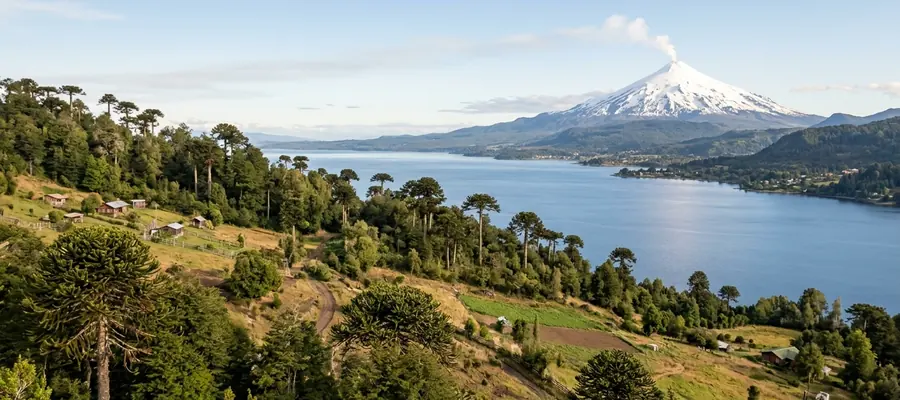
Pucón, Villarrica and Curarrehue, around Lake Villarrica and at the foot of the volcano of the same name, draw buyers of land and rural plots from all over Chile and from abroad. Buying here involves three issues that do not carry the same weight elsewhere: indigenous land, the volcano and the lakeshore. On top of that come the national parks, the araucaria trees and titles that come from regularization processes. This guide brings together what to check before you pay.
Short answer: Villarrica has its own Real Estate Registrar (Conservador de Bienes Raíces), and the Pucón Registrar also covers Curarrehue. Before buying you must rule out that the land is indigenous land, because such land cannot be sold to non-indigenous people and the contract would be void. On the lakeshore, the owner must allow free access when there is no other public road, and jetties and ramps require a maritime concession. The Villarrica volcano has hazard maps, but the zoning plans in force are old. According to our reading of the official map, Curarrehue lies inside the border zone.
Two Registrars for three districts
The Villarrica Real Estate Registrar keeps the records for that comuna, and the Pucón Registrar those for Pucón and Curarrehue. Certificates of current ownership and of mortgages, encumbrances and prohibitions are requested from the one where the land is located. Here, a title study does not stop at confirming who the owner is: it has to look at where the title comes from, because that is where the two risks most typical of the area appear, indigenous land and recent regularization.
Indigenous land: the first thing to rule out
Chile's Indigenous Law protects the land it defines as indigenous, including land that indigenous people or communities hold in ownership under títulos de merced (land grants made by the State) and other titles, and land the State gave or regularized in their favor, including land regularized under Decree Law 2,695. That land cannot be sold, seized, encumbered or acquired by prescription, except between indigenous communities or people of the same ethnic group. Acts that breach this rule are absolutely void.
The practical consequence is serious: a non-indigenous buyer who buys indigenous land acquires nothing, even after paying and even if the deed was signed before a notary. A long lease is not a substitute either: community land cannot be leased or assigned for use, and land owned by indigenous individuals can only be leased for up to five years. We explain this in detail in our guide to why a contract over indigenous land is void.
The issue carries weight here. In March 2025, 47.4% of the people registered in the Social Household Registry in Curarrehue and 24.3% of those in Pucón identified as belonging to an indigenous people. These are figures about people, not land, but they show why the check is not a routine formality. And in 2026 the Ministry of National Assets handed out 109 property titles in Villarrica to beneficiaries from several comunas, 62 of them under an agreement with CONADI, the national indigenous development agency.
CONADI keeps the Public Register of Indigenous Land, and registration in it proves that the land is indigenous. The certificate from that register is requested by the registered indigenous owners, not by third parties, so the practical route for a buyer is the title study: reading the chain back to its origin and spotting whether a título de merced, a division of community land or a regularization in favor of indigenous people appears at any point.
The lakeshore: public access and maritime concessions
Owners of land bordering lakes, rivers or beaches must provide free access to them, for tourism and fishing, when there are no other public roads or paths. The route is set by the regional authority, and closing an access route that has been set carries a fine of 10 to 100 UTM (Chilean monthly tax units).
Works on the shore are a separate matter. In 2022, at the request of the Lake Villarrica harbor master, the Presidential Delegation for La Araucanía, the central government's office in the region, ordered the return of public land occupied without permission: a ramp, jetties and a wall in the La Poza area of Pucón, and another occupation in the Los Guindos area of Villarrica. The lesson for a buyer is simple: an existing jetty or ramp does not come with the title, and if it has no maritime concession, it may have to be removed. Ask for the concession before you pay for it.
The Villarrica volcano and the zoning plans
Chile's planning rules allow zoning plans to define risk areas for volcanic activity. In Pucón, the 2021 environmental report for the zoning plan update notes that the instruments in force are old: an intercommunal plan for Villarrica and Pucón from 1978 and a municipal plan from 1994. The same report acknowledges that an earlier draft treated volcanic hazard very weakly. The 2021 draft ordinance sets as risk areas the zones that can be affected by volcanic activity, such as lahars (volcanic mudflows), but as of this guide we have not confirmed that the update has been approved.
In the meantime, the technical reference is the hazard mapping by SERNAGEOMIN, Chile's geological service, which in December 2025 presented a new hazard map of the volcano's northern sector at a scale of 1:25,000. Check where the land falls on those maps, especially if it is near a stream or channel coming down from the volcano, and ask the municipal Building Department for the certificado de informaciones previas. The fact that the plan in force does not restrict an area does not mean the risk is not there, just as with flood zones.
Curarrehue and the border zone
Nationals of Argentina, Bolivia and Peru cannot acquire real estate in declared border zones without an authorization by supreme decree. Based on our reading of the official layer published by DIFROL, Chile's border authority, Curarrehue lies inside the border zone, while the towns of Pucón and Villarrica lie outside it: the line runs about 27 kilometers east of Pucón, and some eastern parts of that comuna may fall inside. This is a reading of the map, so in a specific case it is worth confirming with DIFROL. For buyers of other nationalities there is no restriction on private land. We explain the rule in our guide to buying land in Chile's border zones.
National parks, araucarias and native forest
The area is surrounded by protected areas: Villarrica National Park, which covers parts of Villarrica, Pucón, Curarrehue and Panguipulli; Huerquehue National Park; and the Villarrica National Reserve. Land next to them should have clearly defined boundaries. The araucaria is a natural monument and felling it is prohibited throughout Chile, as we explain in our guide to araucarias. And any felling of native forest requires a management plan approved by CONAF, the national forestry agency, before cutting, including to open a road or build a house.
Regularized titles and rural plots
According to the Ministry of National Assets, the La Araucanía Region accounts for the largest number of title regularization applications in the country, and the procedure can now take up to 24 months. A title obtained under Decree Law 2,695 makes the possessor the owner after one year of registered possession, but third parties have time limits to bring claims, and if the regularization was in favor of an indigenous person, the land is indigenous land. So a regularized title is not ruled out, but it is read with care. We explain how it works in our guide to regularization of title.
Rural plots are an active market too. In the first half of 2026, La Araucanía had more applications for the subdivision of rural land filed with the SAG, Chile's agricultural service, than any other region: 691 of 2,345 nationwide. Those plots are governed by Decree Law 3,516: lots of at least 5,000 square meters, access to a public space through a right of way at least 5 meters wide that must be registered, and a ban on changing their use. We go through it in our guide to subdividing agricultural land in Chile.
Does this match your situation?
Ask about my case on WhatsAppBuilding in the lake's watershed: permits and septic tanks
On the rural shores of Lake Villarrica, what you can build depends on what it is for. Outside the urban boundary, the law only allows what is needed for farming, the home of the owner and the owner's workers, and certain social housing or homes worth up to 1,000 UF. A hostel, cabins or a campsite are tourism buildings, and before the permit they need a favorable report from the regional housing authority (Seremi de Vivienda) and the SAG, as we explain in our guide to cabins or a tourism business on a rural plot. In every case the works require a permit from the municipal Building Department and final approval before they are occupied, and where there is no water utility, the Building Department asks for a water and sewage project approved by the regional health authority (Seremi de Salud) and, at the end, the certificate for those installations.
Here, sanitation has a rule of its own. The Lake Villarrica Decontamination Plan, approved by Supreme Decree 12 of 2025 of the Ministry of the Environment and published on 13 August 2026, covers the lake's watershed in the comunas of Villarrica, Pucón, Curarrehue and Cunco. The decree bans installing latrines, cesspits or septic tanks without further treatment in new homes and in residential or tourism complexes located within a buffer zone, which the regional environment authority (Seremi del Medio Ambiente) must define within one year of publication. Existing homes and complexes in that zone that use latrines, cesspits or septic tanks without further treatment will have four years from its definition to cut the nutrients in their discharge by at least 50% or connect to a sewer system. Before buying or designing a house in the watershed, ask the Seremi del Medio Ambiente whether the zone has been defined yet and whether it includes the land.
One difference from Temuco and Padre Las Casas: Pucón and Villarrica have no air pollution plan, so no special restrictions on burning firewood apply there. New wood-burning heaters must still meet the national emission standard.
Heritage and archaeological finds
Pucón has no declared historic monuments or typical zones. Villarrica has two historic monuments: the Villarrica Site, which protects the remains of the colonial town, and the Guillatuwe, Paliwe and Eltun ceremonial spaces of the Pedro Ancalef community, in the Putue area. The owner of a privately owned historic monument may not destroy, alter or repair it, or build around it, without prior authorization from the National Monuments Council.
Beyond those sites, the rule that matters is the one on finds. If archaeological remains turn up while digging a foundation or a road, you must notify the Technical Secretariat of the National Monuments Council immediately and, if essential to prevent their destruction or deterioration, stop the works in the specific area of the find. In a town founded on a colonial settlement, it is worth allowing for this before setting a construction timetable.
If you are buying from abroad
The RUT, the power of attorney and the safe way to pay work the same way as in the rest of the country, and we cover them in our guide to closing a property purchase in Chile. Two points are specific to this area. If you sign a promesa before the title study, put in writing what happens to the deposit if indigenous land turns up, as we explain in our guide to the promesa de compraventa. And if you plan to rent the house to tourists by the season while you live abroad, check first how that income is taxed, in our guide to renting out property in Chile from abroad. The Villarrica and Pucón Registrars are outside Santiago, Valparaíso, Viña del Mar and San Miguel, so the fee schedule allows them a registration surcharge up to 50% higher than in those cities.
Property tax: agricultural and non-agricultural properties
In Curarrehue, almost half of the properties are agricultural: according to the SII's statistics for the second half of 2025, 2,861 of its 5,853. In Pucón the share is much lower: 4,622 of 34,903. The series matters because it changes the exempt amount, which from 1 July 2026 is CLP 50,177,135 for agricultural land and CLP 61,711,570 for non-agricultural residential property, and which is deducted from the fiscal appraisal to calculate the tax. A recreational plot (parcela de agrado), where farming is absent or secondary, goes into the non-agricultural series, while land that can be used predominantly for farming, livestock or forestry stays in the agricultural series even if it is not farmed. If your property's appraisal seems high, our property tax team can review it.
What to check, depending on the land
Frequently asked questions
How do I know whether land in Pucón is indigenous land?
Through a title study that reads the chain back to its origin. If a título de merced, a division of community land or a regularization in favor of an indigenous person appears at any point, the land may be indigenous land, and selling it to a non-indigenous person would be void.
Can I lease indigenous land for 30 or 99 years?
No. Indigenous community land cannot be leased, and land owned by indigenous individuals can only be leased for up to five years. A contract that breaches these rules is void.
The land I am being offered has a jetty. Does it come with the sale?
Not necessarily. Works on the shore require a maritime concession, and in 2022 the authorities ordered the return of public land where jetties and ramps had been built without permission on Lake Villarrica. Ask for the concession before paying for the jetty.
Can a foreigner buy in Pucón?
Yes. The only restriction applies to nationals of Argentina, Bolivia and Peru in the border zone, which here covers Curarrehue and possibly eastern parts of Pucón.
Do you have an office in Pucón or Villarrica?
We do not have a physical office in the lake district, but we take cases in Pucón, Villarrica and Curarrehue: we review the titles with the Villarrica and Pucón Registrars without you having to go, and we go on site when the property has to be measured or inspected.
Can I install a septic tank in a new house near Lake Villarrica?
Only with further treatment if the house falls within the buffer zone of the lake's decontamination plan. In any case, where there is no public network, the drinking water and sewage project must be approved by the Seremi de Salud and the system authorized before it is put into use.
Are there restrictions on burning firewood in Pucón?
Pucón and Villarrica have no air pollution plan, so no special restrictions apply there. New wood-burning heaters must meet the national emission standard.
How we can help
At Terreno en Regla we work in Pucón, Villarrica and Curarrehue, although we do not have a physical office in the area. We carry out the title study, reading the chain back to its origin to rule out indigenous land, survey the property and, if the title comes from a regularization or needs one, we handle the title regularization. If you live outside Chile, we coordinate everything remotely. Write to us with the location or tax roll number of the land. You can find every way to reach us on our contact page.
Tell us your situation and we will tell you what applies.
Talk to a lawyer on WhatsApp