Buying land in Chiloé: the coastline, indigenous land and regularized titles
- Four Registrars on the island
- Titles that come from regularizations
- Indigenous land in Chiloé
- The coastline: access, the 80-meter strip and concessions
- Coastal marine spaces of indigenous peoples
- Forest, alerces and rural plots
- Churches, typical zones and what can be built near them
- A house in the Chiloé countryside: permits and water
- If you are buying from abroad
- Property tax: many agricultural properties
- What to check, depending on the land
- Frequently asked questions
- ↳ Can an ECMPO take my land?
- ↳ Can I buy the beach land in front of my property?
- ↳ The title comes from National Assets. Is it safe to buy?
- ↳ Can a foreigner buy land in Chiloé?
- ↳ Do you have an office in Chiloé?
- ↳ Can I build a house next to one of Chiloé's churches?
- ↳ Does the Austral Law apply in Chiloé?
- How we can help
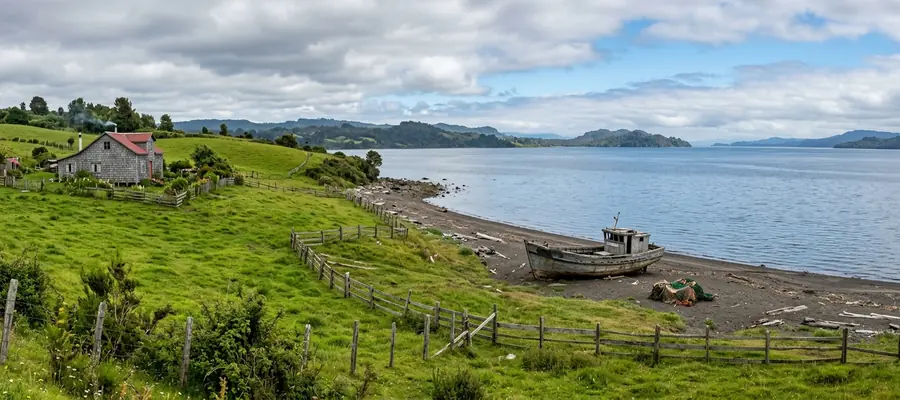
Chiloé draws buyers looking for land facing the sea, a plot with forest or a house in the countryside, often from Santiago or from abroad. Buying on the island has particular features worth knowing before you pay: there are four different Registrars, many titles come from regularization programs, some of the land is indigenous land, and the coastline has its own rules, including the coastal marine spaces of indigenous peoples. This guide brings together what to check.
Short answer: Chiloé's records are split among four Real Estate Registrars: Castro, Ancud, Quellón and Quinchao. Many titles on the island come from regularizations, and land regularized in favor of an indigenous person is indigenous land, which cannot be sold to non-indigenous people. On the coast, the owner must allow free access to the beach when there is no other road, State beach land within the 80-meter strip from the high-water line is managed through concessions, and works on the shoreline require a maritime concession. Coastal marine spaces of indigenous peoples do not cover registered private property, but they can cover the beach in front of your land. Chiloé lies outside the border zone.
Four Registrars on the island
Certificates and registration are requested from the Registrar (Conservador de Bienes Raíces) for the comuna where the land is located:
- Castro: Castro, Chonchi, Dalcahue, Puqueldón and Queilén.
- Ancud: Ancud and Quemchi.
- Quellón: Quellón.
- Quinchao, based in Achao: Quinchao and Curaco de Vélez.
When the land is near the boundary between two comunas, confirm the comuna from the property's tax roll number before requesting anything. What to request and why is in our guide to the checks before you wire the money.
Titles that come from regularizations
In Chiloé, the Ministry of National Assets has regularized titles through several routes: Decree Law 2,695, which regularizes possession of small private properties; Decree Law 1,939, on State property; and Law 19,776, known as the southern law (ley del sur), which included the province of Chiloé. That is why the chain of title of a piece of land may begin with a resolution from National Assets rather than an old sale.
A title regularized under Decree Law 2,695 is not a bad title, but it has to be read on its own terms. On registration, the beneficiary becomes a regular possessor, and after one full year of uninterrupted registered possession becomes the owner. During that year, third parties can bring ownership claims, and after it they have up to five years to demand monetary compensation. If you are buying land regularized recently, the registration date matters. We explain how it works in our guide to regularization of title.
Many old rural titles describe the boundaries by reference to neighbors, streams or roads that no longer exist. A topographic survey comparing the land with what the title says avoids surprises, and if the area does not match, there are ways to correct it, as we explain in our guide to rectifying registered area and boundaries.
Indigenous land in Chiloé
Chile's Indigenous Law recognizes as Mapuche Huilliche the communities located mainly in the former Tenth Region, which includes Chiloé. In Castro, 27.4% of the people registered in the Social Household Registry identified as belonging to an indigenous people in March 2025.
What makes the issue especially relevant on the island is a rule in the law itself: land that the State gave or regularized in favor of indigenous people or communities is indigenous land, including land regularized under Decree Laws 2,695 and 1,939. In an area where many titles come from regularizations, that means you have to check in whose favor the land was regularized. Indigenous land cannot be sold, seized, encumbered or acquired by prescription, except between indigenous communities or people of the same ethnic group, and acts that breach this rule are void. We explain it in our guide to why a contract over indigenous land is void.
The coastline: access, the 80-meter strip and concessions
Land facing the sea comes with three rules worth knowing:
- Beach access. Owners of land bordering beaches must provide free access to them, for tourism and fishing, when there are no other public roads or paths. The regional authority sets the route, and closing it carries a fine of 10 to 100 UTM (Chilean monthly tax units).
- The 80-meter strip. Beaches and State beach land within an 80-meter strip measured from the high-water line are managed through maritime concessions. A jetty, a ramp or a building over the water is not authorized by the title to the land above it.
- If the beach land belongs to the State and you want to buy it. In the Los Lagos, Aysén and Magallanes regions, State beach land can be transferred only to Chilean individuals or Chilean non-profit legal entities, with a favorable report from the Navy and provided the buyer settles in the region, and it is subject to restrictions on resale for ten years. State land within 5 kilometers of the coast can be granted to foreigners only if they are domiciled in Chile and with a prior favorable report.
These last two rules apply to State land, not to private land that already has a registered owner. But a topographic survey is the only way to know whether the boundary in the title reaches the high-water line or whether a strip of State land lies between the two.
Coastal marine spaces of indigenous peoples
Law 20,249, known as the Lafkenche law, allows the declaration of coastal marine spaces of indigenous peoples, known as ECMPO, to safeguard the customary use of indigenous communities. An ECMPO can include sea beaches, State beach land, portions of water and seabed, and rocks, but not rivers or lakes, and it is established with respect for the rights of third parties. It does not cover registered private property.
What it can do is cover the State beach land in front of a private property. If another application covers the same area, for example a maritime concession for a jetty, its processing is suspended until CONADI, the national indigenous development agency, issues its report. In November 2026, the public register kept by Subpesca, the fisheries undersecretariat, showed 51 ECMPO applications in Chiloé's comunas, 12 of them already granted, and 37 that include beach land. There were applications in Quellón, Ancud, Chonchi, Quinchao, Quemchi, Castro and Queilén, and none in Dalcahue, Curaco de Vélez or Puqueldón. If your project depends on using the coast, check the ECMPO map before you buy.
Forest, alerces and rural plots
Any felling of native forest requires a management plan approved by CONAF, the national forestry agency, before cutting, and the alerce is a natural monument whose felling is prohibited. Chiloé National Park covers parts of Ancud, Dalcahue, Castro and Chonchi, so land next to it should have clearly defined boundaries. We explain the rules in our guide to cutting trees on your land.
Rural plots are governed by Decree Law 3,516: lots of at least 5,000 square meters, access to a public space through a right of way at least 5 meters wide that must be registered, and a ban on changing their use. If the lot does not open directly onto a public road, check that the right of way appears on the plan certified by the SAG, Chile's agricultural service, and at the Registrar. If there is no access, our guide to right of way easements explains when one can be required.
Chiloé lies outside the border zone, so the restriction on buyers from Argentina, Bolivia and Peru does not apply on the island.
Does this match your situation?
Ask about my case on WhatsAppChurches, typical zones and what can be built near them
Sixteen of Chiloé's wooden churches have been on the World Heritage List since 2000, among them those of Castro, Nercón, Chonchi, Achao, Dalcahue and Tenaún. They are historic monuments, and several also have a typical zone (zona típica) around them. Today the typical zones include the historic center of Castro, which has its own intervention rules; the surroundings of the Nercón and Chelín churches, in Castro; Centenario street and the surroundings of Vilupulli, in Chonchi; the village of Tenaún and the surroundings of the San Juan church, in Dalcahue; Villa Quinchao; the surroundings of the Colo church, in Quemchi; and the surroundings of Ichuac, Detif and Aldachildo, in Puqueldón.
This matters when you buy land or a house in those areas. Building in a typical zone, or rebuilding or conserving what is there, requires prior authorization from the National Monuments Council (Consejo de Monumentos Nacionales), which is only granted when the works are in keeping with the general architectural style of the zone. The owner of a historic monument may not destroy, alter or repair it, or build around it, without the Council's authorization, and the Council sets the rules the works must follow. If the land you are being offered is next to one of these churches, find out whether it lies inside the typical zone before you design a house.
A house in the Chiloé countryside: permits and water
A house for the owner is within what the law allows to be built outside the urban boundary, along with what is needed for farming and certain social housing or homes worth up to 1,000 UF. Cabins or tourist accommodation, on the other hand, first need a favorable report from the regional housing authority (Seremi de Vivienda) and the SAG. Either way, you need a permit from the municipal Building Department, and the house may not be occupied before its final approval.
In the countryside, one practical question is water. Where there is no water utility, the permit requires a drinking water and sewage project approved by the regional health authority (Seremi de Salud), which then authorizes the system before it is used. Rural sanitation services run by non-profit committees or cooperatives also operate on the island, and it is worth asking whether the land can connect to one before planning a well of your own.
If you are buying from abroad
The RUT, the power of attorney and payment work the same way as in the rest of the country: an attorney in fact in Chile requests the RUT under a power you sign, your representative can sign the deed, and the price stays in the notary's custody until registration, as we explain in our guide to closing a property purchase in Chile. If you sign a promesa first, it should say what happens to the deposit if the review of a regularized title goes badly (promesa de compraventa). Chiloé's Registrars are outside Santiago, Valparaíso, Viña del Mar and San Miguel, so the maximum registration surcharge is 50% higher than in those cities.
If your plan is a house to rent to tourists by the season and you live abroad, that rental has its own tax rules, which we bring together in our guide to renting out property in Chile from abroad. And if you already own property on Chiloé, we can check it from abroad.
Property tax: many agricultural properties
In several of Chiloé's comunas, most properties are agricultural. According to the SII's statistics for the second half of 2025, in Quemchi 4,018 of 6,389 were agricultural, and in Quinchao 3,891 of 5,765. In Ancud, the comuna with the most properties on the island, the share is lower: 9,749 of 33,053. Land that can be used predominantly for farming, livestock or forestry stays in the agricultural series even if it is not farmed, while a recreational plot (parcela de agrado), where farming is absent or secondary, moves to the non-agricultural series. The difference shows in the exempt amount, which from 1 July 2026 is CLP 50,177,135 for agricultural land and CLP 61,711,570 for non-agricultural residential property, and which is deducted from the fiscal appraisal to calculate the tax. If the appraisal seems high, our property tax team can review it.
What to check, depending on the land
Frequently asked questions
Can an ECMPO take my land?
No. A coastal marine space of indigenous peoples does not cover registered private property and is established with respect for third-party rights. What it can affect is the State beach land in front of your property and the processing of a maritime concession in that area.
Can I buy the beach land in front of my property?
In Los Lagos, State beach land can only be transferred to Chilean individuals or Chilean non-profit legal entities, with a favorable report from the Navy and settlement in the region. To use it, the usual route is a maritime concession.
The title comes from National Assets. Is it safe to buy?
It can be, but you need to check the registration date, because third parties have time limits to bring claims, and in whose favor the land was regularized, because if it was an indigenous person, the land is indigenous land.
Can a foreigner buy land in Chiloé?
Yes. Chiloé is outside the border zone, so there is no restriction based on nationality for private land. The special rules for foreigners apply to buying State land near the coast.
Do you have an office in Chiloé?
We do not have a physical office on the island, but we work on Chiloé: we request the certificates from the Castro, Ancud, Quellón or Quinchao Registrars remotely, and our surveyors cross to the island when the land has to be surveyed.
Can I build a house next to one of Chiloé's churches?
It depends on where the land is. Inside a typical zone, the works need prior authorization from the National Monuments Council, which is only granted if they are in keeping with the zone's architectural style. Outside it, the law requires that authorization from the church's owner to build around it; if your land borders a church that is a historic monument, consult the Council before designing. In both cases you will also need the Building Department's permit.
Does the Austral Law apply in Chiloé?
No. The Austral Law's tax credit applies to investments in the Aysén and Magallanes regions and the province of Palena, but not in the province of Chiloé.
How we can help
At Terreno en Regla we work in Chiloé, although we do not have a physical office on the island. We carry out the title study at the relevant Registrar, read the regularizations and rule out indigenous land, survey the property to show where it ends against the sea and, if the title needs work, we handle the title regularization. If you live outside Chile, we coordinate everything remotely. Write to us with the location or tax roll number of the land. You can find every way to reach us on our contact page.
Tell us your situation and we will tell you what applies.
Talk to a lawyer on WhatsApp