Can I cut down the espinos on my land? What the law requires before you touch them
- The value of the espino and its legal protection
- The three legal scenarios: which is yours?
- What to prepare before starting the process
- The process before CONAF: deadlines and requirements
- Warning about clearing land
- What you risk if you cut without a permit
- How we help at Terreno en Regla
- Summary table of procedures
- Frequently asked questions
- ↳ Can I remove espinos to make an agricultural paddock?
- ↳ Do I need a permit to remove a single espino in my yard?
- ↳ Can I use dead espinos for my own firewood?
- ↳ What happens if you have already cut without authorisation?
- ↳ How long does CONAF take to approve the management plan?
- ↳ Who can prepare the management plan or the exclusion report?
- ↳ How do I know whether my espinos count as forest or scrubland?
The value of the espino and its legal protection
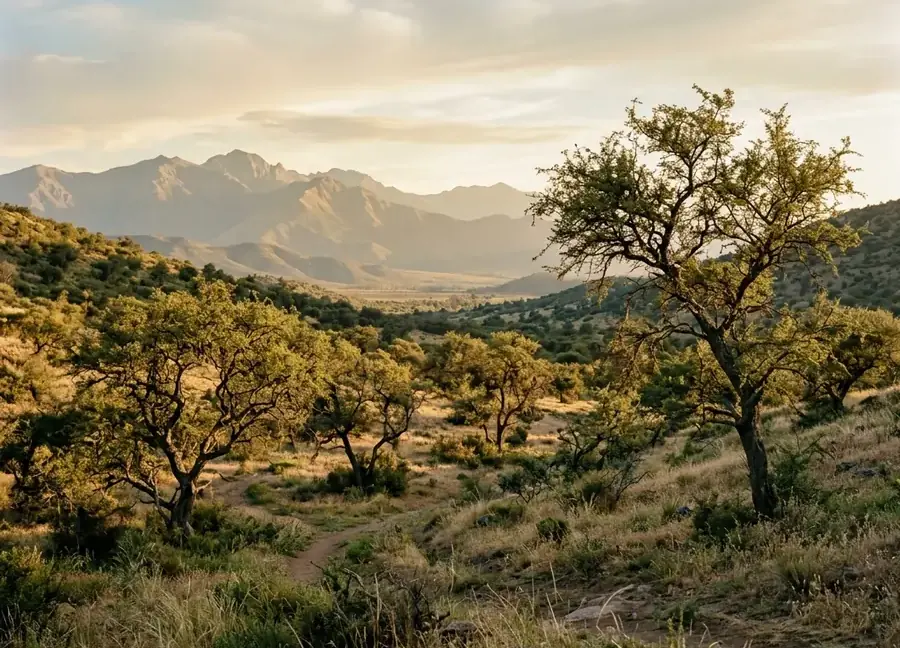
The espino, scientifically known as Acacia caven or Vachellia caven, is one of the most common and recognisable tree species in the landscape of central Chile. Despite its abundance and being sometimes seen as a weed, it plays a fundamental ecological role. This pioneer species can colonise heavily degraded soils, fixing nitrogen and halting processes of desertification or severe erosion. Its foliage also provides shelter and food for various local wildlife species, creating a vital microclimate in areas of prolonged drought.
Because of these invaluable ecosystem services, the Chilean State protects espino stands under Law number 20.283 on Native Forest Recovery and Forestry Development. Unlike what happens with pines or eucalyptus, the legislation presumes the high environmental value of every endemic or native species. Cutting an espino stand without a prior technical assessment involves not just an administrative risk for the landowner, but a setback in soil recovery in a country heavily affected by water scarcity.
The three legal scenarios: which is yours?
The most common question among people buying a parcel is what permit they need. The rules set out three broad scenarios, and the classification is not decided by the owner's eye, it requires a technical field report prepared by a qualified forestry professional.
The first scenario arises when the vegetation meets the legal definition of forest. This means the espinos cover a minimum area, with a certain density and canopy cover. In this case, applying for a management plan with CONAF is compulsory. The second scenario applies when the trees do not form a dense forest, but are located in protected areas, such as steep ravines or near watercourses. Here, the law requires applying for a cutting permit for isolated trees. Finally, the third scenario arises when the shrubs are scattered outside risk zones and do not reach the thresholds to be considered a forest; in this situation, the correct route is to file an exclusion report so the authority can confirm that cutting is unrestricted.
What to prepare before starting the process
Before contacting a forestry professional, gather the information that will speed up the assessment of your property. A plan or georeferenced location of the land, the property tax roll number, and general photographs of the area where the espinos are located let a forestry engineer form an initial impression before the site visit. If you do not yet have an up to date plan, our surveying service can produce one. If the ultimate goal is to prepare the land for agriculture or for a subdivision, also have the details of that subdivision on hand, because the forestry assessment and the subdivision assessment are usually reviewed together.
The accredited professional's site visit is, in every case, the step that determines whether a management plan, a cutting permit or an exclusion report applies. Providing this information in advance does not replace that visit, but it does reduce the time between the first contact and the formal filing of the application with CONAF.
The process before CONAF: deadlines and requirements
Article five of the Native Forest Law is emphatic: any cutting of native forest must be carried out under an approved Management Plan. This technical document must be prepared by a forestry engineer, agronomist, or other duly accredited professional. The plan not only justifies extracting the timber, it also sets out the compulsory reforestation or regeneration measures needed to maintain the property's ecological balance.
Once the application has been filed through the CONAF official platform, article seven of the same law provides that the institution has a maximum of ninety days to issue a ruling. If that period elapses without the authority raising objections or issuing a rejection, positive administrative silence applies, and the plan is deemed approved. In practice, however, it is essential to have the formal resolución exenta in hand before starting a chainsaw, to avoid misunderstandings during later inspections.
Warning about clearing land
One of the points that causes the most friction with the authority is cutting vegetation to clear land for farming purposes or subdivision projects. It is crucial to understand that obtaining a management plan to clear large areas is not an automatic process. The Ministry of Agriculture has recently implemented strict joint administrative guidelines with CONAF, severely limiting authorisations for clear cutting when the ultimate purpose is to subdivide, in line with the new rules on rejecting parcel subdivisions.
If your goal is to prepare the land for subdivisions that involve subdividing agricultural land, the technical assessment will be extraordinarily strict. We advise you to properly find out about the exact requirements for subdividing farmland before planning a drastic intervention in the native landscape, which could end up flatly rejected by the forestry corporation.
Does this match your situation?
Ask about my case on WhatsAppWhat you risk if you cut without a permit
The penalties set out in title nine of the current forestry law are extremely severe for anyone acting outside the rules. Intervening in native forest, or ordering third parties to do so, without a duly approved plan constitutes an offence classified as unauthorised cutting. Fines are calculated based on the commercial value of the products cut, or, failing that, in monthly tax units (UTM) applied per hectare irregularly affected.
Besides the severe financial fines and the possible seizure of the firewood or timber, the offender takes on an unavoidable obligation that the Local Police Courts watch closely: the obligation to reforest an area equal to or greater than the one affected, under an environmental correction plan. Cutting without a permit never exempts the person responsible from having to make good the ecological damage caused, a rule that applies with equal severity to other species we will cover shortly, as in our analysis of the legal protection of the araucaria.
How we help at Terreno en Regla
Dealing with forestry procedures requires intertwined technical and legal knowledge. Our firm takes a leading role advising owners throughout the whole process of applying for the permits and management plans needed for controlled extraction of espinos. We coordinate directly with forestry engineers to prepare the technical report and take on legal representation before CONAF's offices, making sure the file is not rejected because of formal defects.
As an essential preliminary step, we always recommend carrying out a title study to make sure ownership of the land to be worked on is free of disputes. Likewise, if you need to delimit protected areas or produce base plans for the management plan, we have a department specialising in surveying and architecture services ready to support you with high precision instruments.
To guide you from the first contact, tell us which scenario you think your land falls into, and send us the forestry report if you already have one, or a photo and the approximate location of the specimens if you do not have one yet. With that we can tell you whether you will need a management plan, a cutting permit for isolated trees or an exclusion report, and coordinate the site assessment with our associated professionals. The first assessment is free.
Summary table of procedures
| Situation on the ground | Do I need a permit? | Assessing institution | Resulting document |
|---|---|---|---|
| Meets the definition of native forest | Compulsory in every case | Corporación Nacional Forestal | Approved Management Plan |
| isolated trees near streams | Compulsory because of protected area | Corporación Nacional Forestal | Specific cutting permit |
| Minor scrubland not forming a forest | Requires prior validation | Accredited forestry engineer | Technical exclusion report |
Frequently asked questions
Can I remove espinos to make an agricultural paddock?
Do I need a permit to remove a single espino in my yard?
Can I use dead espinos for my own firewood?
What happens if you have already cut without authorisation?
How long does CONAF take to approve the management plan?
Who can prepare the management plan or the exclusion report?
How do I know whether my espinos count as forest or scrubland?
Tell us your situation and we will tell you what applies.
Talk to a lawyer on WhatsApp