Araucarias: why felling them is banned across Chile and what to do if you have one on your land
- Natural Monument status and the significance of the Pehuén
- The decree's restrictive exceptions
- I have an araucaria on my land: what I can and cannot do
- What you risk if you fell or damage an araucaria
- What to check before buying land with araucarias
- Practical consequences of having araucarias on your property
- What to do if your land has araucarias
- Our service: legal compliance and defence
- Comparative table of legal regimes
- Frequently asked questions
- ↳ Can I fell an araucaria if it is in my own urban garden?
- ↳ What happens if the araucaria has died naturally or threatens to fall?
- ↳ Can I build my house near an araucaria?
- ↳ What happens if a neighbour fells an araucaria on their property?
- ↳ What should I check before buying land with araucarias?
- ↳ Do I inherit liability if the previous owner had an araucaria infraction?
Natural Monument status and the significance of the Pehuén
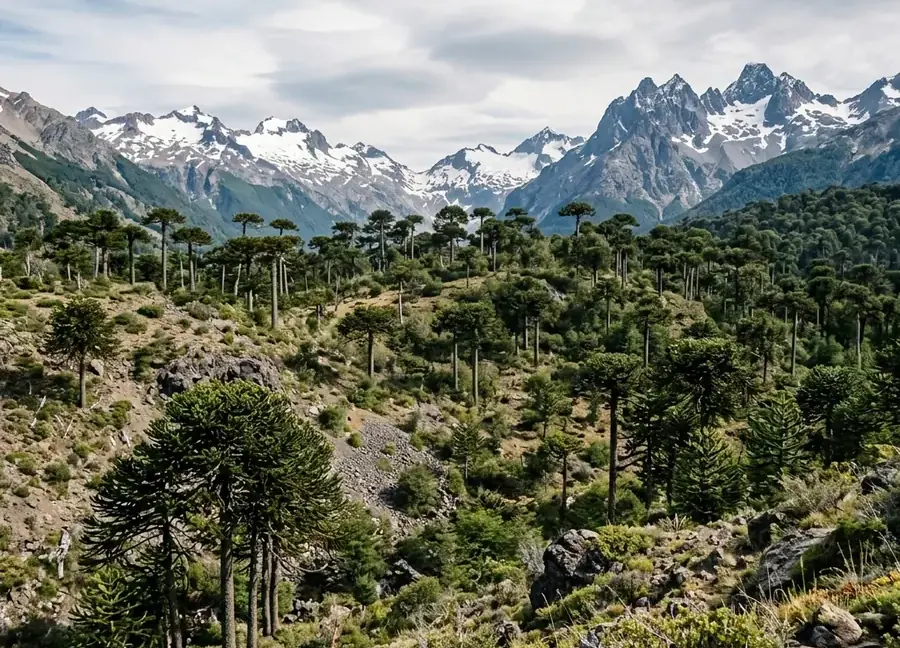
Supreme Decree number forty three of the Ministry of Agriculture established the species Araucaria araucana as a Natural Monument. Under Chilean environmental law, this is the highest protection category a plant species can receive, which translates into its absolute protection. The regulation holds that preserving this conifer outweighs the right to private property, given its incalculable botanical and ecological value, so the restrictions reach every corner of the country.
Beyond its scientific importance, the araucaria (or pehuén) carries a profound spiritual and cultural significance for the Mapuche Pehuenche people. Historically, their communities have lived alongside these mountain forests, basing much of their traditional subsistence on the respectful gathering of its seed, the piñón. The Natural Monument declaration implicitly recognises this heritage, protecting a vital ecosystem that is inseparable from the indigenous identity of the southern mountain range.
The decree's restrictive exceptions
Unlike species such as the espino, whose felling is regulated and can be processed through a standard management plan before CONAF, intervening in a living araucaria is of an entirely exceptional nature. The law states categorically that the forestry corporation may only authorise felling in writing, through its top director, in four narrowly defined scenarios.
Those scenarios are: carrying out duly justified scientific research, clearing land strictly necessary for public works, urgent national defence works that cannot be postponed, and forest management plans carried out exclusively by official State bodies for the sole purpose of conserving and improving the species. Outside these four cases, no private individual, property developer or forestry company can validly apply for a permit to fell a living specimen.
I have an araucaria on my land: what I can and cannot do
If you have acquired a plot with living araucarias, your duty is one of passive conservation. You cannot fell them, uproot them, burn them or damage them while building. Any construction, road layout or utility installation must be designed to respect the area covered by the tree's roots and canopy.
The question that frequently comes up is what happens with dead, fallen trees, or ones that, because of how they lean, pose a clear structural risk to a home. In these cases of dead specimens (legally defined as those with no photosynthetic activity, foliage entirely lost and destroyed cambium), using or removing them does require prior approval of a management plan before CONAF. This process is not automatic: it requires reforesting with at least a thousand araucaria seedlings per hectare in the following season, and the authority has an express mandate to reject the plan if it is presumed the tree's death was caused by human intervention, such as a deliberate fire.
What you risk if you fell or damage an araucaria
Intervening in a Natural Monument carries the harshest consequences under the Chilean forestry penalty system. Felling an araucaria without falling under one of the exception scenarios and without the authority's signature is treated as unauthorised felling under the Native Forest Act. The fines are severe and are applied per damaged specimen or per hectare affected, along with confiscation of any products obtained and the unavoidable court ordered obligation to reforest or restore the ecosystem.
This is a matter of the highest priority for the State. Recent audits by the Contraloría General de la República (the national comptroller's office) have detected and challenged irregular felling of the species even inside State wilderness areas, which shows that enforcement over the pehuén is an active and rigorous matter. Any infraction can lead to environmental damage liability that escalates quickly in the competent courts.
What to check before buying land with araucarias
If you are considering buying a property in a mountain or foothill area in the south, the presence of araucarias is something worth checking with the same seriousness as checking whether a piece of land floods before signing. The araucaria does not appear on the current title certificate or on just any survey plan, and yet it determines what can be built, and where.
It is worth gathering at least four pieces of information before committing. First, how many specimens are on the property and whether they are alive, dead, or at obvious risk of falling. Second, whether the seller or a previous owner ever faced a complaint or a sanctions procedure relating to these trees, because that kind of liability can end up carrying over to whoever buys afterwards. Third, whether the project you have in mind, a house, a subdivision or a cabin, is compatible with respecting the root zone and canopy of each specimen without having to redesign the whole build. And fourth, if you are also planning to subdivide the property, that the subdivision be processed independently before the relevant bodies, as we explain in the guide on the ley Sabag.
Does this match your situation?
Ask about my case on WhatsAppPractical consequences of having araucarias on your property
Beyond the penalty for felling them, the mere presence of living araucarias on a property has practical effects worth anticipating. The first is the floor area actually available to build on: if the house design, the access road or the utility lines encroach on the root zone or the canopy, the whole project is exposed to a complaint, even if the tree itself is never directly touched.
The second is managing dead specimens. Unlike other resources that may be found on rural land, such as sand or gravel, which are extracted with a relatively simple authorisation, a dead tree of this species requires a specific management plan and the obligation to reforest, so removing it on your own, even if it is completely dry, exposes you to a penalty just as severe as felling a living specimen.
The third is the level of enforcement to expect. Since the Contraloría has challenged irregular felling even inside State wilderness areas, it is reasonable to assume an equivalent level of scrutiny on a private property with araucarias, especially if there are fallen specimens or signs of recent intervention on the land.
What to do if your land has araucarias
If you are already the owner, the first step is to document the condition of each specimen as soon as you take possession: dated photographs and, if possible, a technical report. That documentation does not prevent an inspection, but it does let you prove, if you are ever asked, that a dry or fallen tree was already in that state when you bought the property and that the cause was not something you did.
Any works, from an extension to laying out an internal road, must be designed to respect the root zone and canopy from the outset, not as an adjustment made later. And if you need to remove a dead specimen that poses a real risk to a home, the route is always a management plan before CONAF, never a unilateral decision to fell it or let it fall.
Besides respecting the root and canopy zone, any construction on the property still needs the relevant municipal permits: not having them brings its own penalties, separate from the ones CONAF applies over the protected species, as we explain in the article on Municipal Building Department fines for building without a permit.
Our service: legal compliance and defence
At Terreno en Regla, our policy is clear: we do not chase illusory permits to fell living araucarias for private purposes. Our work as specialist lawyers focuses on protecting your legal and financial security through strict compliance with forestry law.
We advise owners and developers on property audits before buying or subdividing, checking through a title study and a technical review whether the project is workable alongside the protected species. We also provide representation in court proceedings and litigation before Local Police Courts or administrative bodies if you face complaints or sanctions procedures arising from accidents, dead trees falling, or infractions that occurred before your purchase.
We are Terreno en Regla, and we have our own team of lawyers, surveyors and architects, which lets us check the exact location of each specimen and its root zone on site, not just the paperwork of the title, before deciding whether a project is workable. If you also need to sort out the rest of the property, we can help you work out how much it costs to regularise the whole property.
The first review is free. Send us the property's rol, the title deed, or the CONAF notice you received, and we will tell you whether the project you have in mind is workable with the trees left standing and what information is worth gathering before moving forward.
Comparative table of legal regimes
| Species | Main legal regime | Can private individuals apply to fell it? | Competent authority |
|---|---|---|---|
| Espino | General Preservation Native Forest | Yes, through a Management Plan | CONAF provincial office |
| Araucaria | Untouchable Natural Monument | No, absolute prohibition | CONAF Executive Director (exceptions only) |
Frequently asked questions
Can I fell an araucaria if it is in my own urban garden?
What happens if the araucaria has died naturally or threatens to fall?
Can I build my house near an araucaria?
What happens if a neighbour fells an araucaria on their property?
What should I check before buying land with araucarias?
Do I inherit liability if the previous owner had an araucaria infraction?
Tell us your situation and we will tell you what applies.
Talk to a lawyer on WhatsApp