Selling a property in Chile without travelling
You can sell without setting foot in Chile. What holds sales up is not the distance but the title: inheritances never registered, square metres without approval and surface areas that do not match.
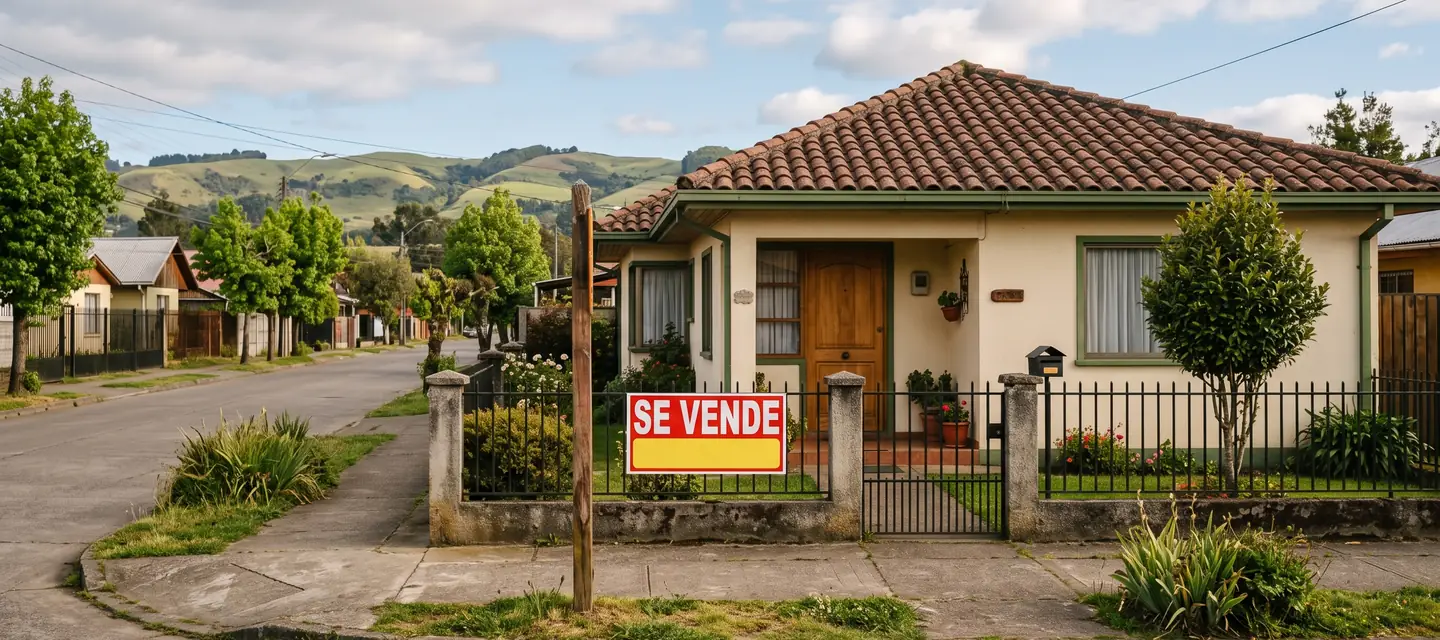
Yes it can be done, and it is one of the dealings that work best at a distance. You grant a special power of attorney with express authority to sell and a representative signs the deed in Chile. What makes these sales fail is almost never the power of attorney: it is the state of the title. An inheritance that was never registered, built square metres without final municipal approval or a surface area that does not match the land bring the transaction to a halt after a buyer is already there, and correcting that at a distance takes months.
Check it before you offer the property, not afterwards
The order we recommend is the reverse of the usual one. Most people put up the listing, an interested buyer appears, a promise to sell is signed with a deadline and only then does somebody look at the title. When the problem shows up, there is a date running and an impatient counterparty.
A title review done before listing changes the whole conversation: you know what you are selling, you know what has to be put right and you know how long it takes. And if there is nothing to put right, you know that too, which is a selling point.
The four findings that most often hold up a sale from abroad are the property still registered in the name of somebody who has died, buildings without final municipal approval, the registered surface area not matching the real one, and debts for contribuciones (the annual property tax) or common expenses that travel with the property.
The most frequent case: the house is still in the name of the father
It is, by a wide margin, what we come across most often. The family obtained the posesión efectiva (the estate probate filing) years ago, put the paper away and never made the special inheritance registration. The property is still registered in the name of the person who died and so there is nobody able to sell it.
It is not a dead end and it is resolved entirely at a distance, but it is a procedure with timeframes of its own that has to be done before committing to a buyer. The detail is on the page on inheritance from abroad.
The power of attorney, with the right authority
To sell, express authority is needed: article 2132 of the Civil Code confines the ordinary mandate to acts of administration, and selling is not one of them. It is also worth having the power of attorney cover the steps that go with a sale and are often forgotten: receiving the price, releasing mortgages, executing the supplementary instruments and representing the seller before the Real Estate Registrar if there are objections.
How it is granted and what comes afterwards is in the guide to the power of attorney from abroad. The only thing worth repeating here is the calendar: the whole chain is measured in weeks, so it is started before signing a promise to sell and not afterwards.
The taxes on selling, which change if you are not a resident
This is the point where most people get a surprise. Chilean law treats the gain on the sale of a property by an individual generously: there is a bracket of up to 8,000 unidades de fomento of capital gain that can be treated as non taxable income, and on the excess there is the option of a single substitute tax of 10 percent.
That regime is reserved for individuals domiciled or resident in Chile, along with other requirements such as having held the property for more than a year. Somebody who lives abroad and is not a resident falls outside that treatment and is taxed under the general rules applying to non residents, with withholding at source.
The practical consequence is that the question of whether you will be resident in Chile in the year of the sale is not an accounting detail: it changes the arithmetic of the whole transaction. And it is a question worth answering before selling, not in April of the following year.
What happens with the price
It is worth settling before signing anything, because it is where mistrust arises. The usual arrangement is for the price to be paid against registration at the Real Estate Registrar, by cashier's check or by notarial escrow instructions that set when and against which document the money is released.
For somebody living abroad there is an additional layer: transferring the money out of the country has rules of its own and it is best settled with the bank before the deed and not afterwards. The power of attorney must expressly authorise receiving the price, and it is worth putting in writing which account it is paid into.
If the property is let or occupied
Selling a property with a tenant inside can be done, and what has to be checked is whether that tenancy will be enforceable against the buyer, which depends on the form of the contract and on the dates. If the property is occupied without a contract, the situation is different and has to be resolved first, because no buyer with a lawyer signs a sale over an occupied property. The routes for each case are on the page on tenancies and collection from abroad.
Frequently asked questions
Can I sell without coming to Chile at any point?
How long does selling from abroad take?
I inherited the property and we never registered it. Can I sell it anyway?
I sold years ago and never declared anything in Chile. Do I have a problem?
There are extensions built without a permit. Can it still be sold?
Who pays the overdue contribuciones?
Can I sell only my part if there are several of us siblings?
Further reading
Other areas from abroad
Tell us about your case
With whatever background you have to hand, we can tell you where the matter stands and which procedure applies. The first conversation is free and commits you to nothing.
Message us on WhatsApp