The power of attorney to act in Chile from abroad
The piece that unlocks everything else. How it is granted from abroad, what authority it has to carry, and why the 2026 notarial reform did not make it as digital as it looks.
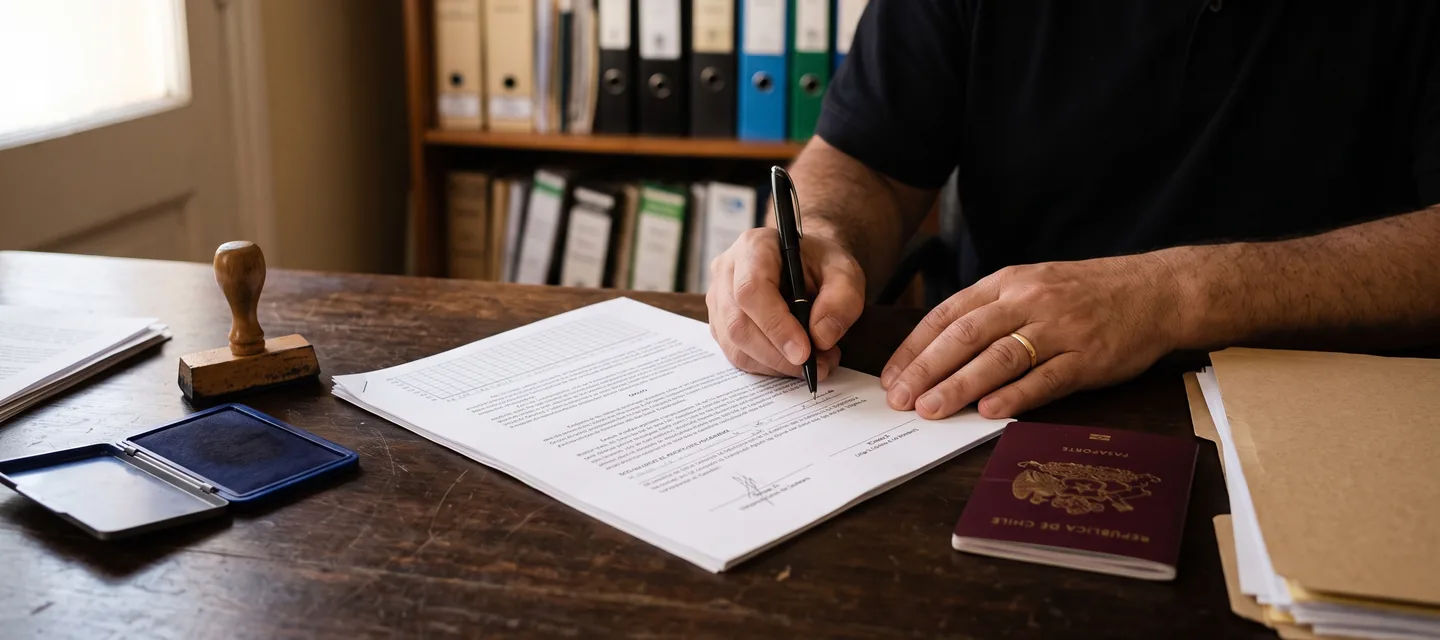
There are two routes and both of them work. One is to grant the power of attorney before the Chilean consulate in your city, where the consul acts as a certifying officer just as a notary does in Chile. The other is to sign it before a notary in the country where you live and have it apostilled, something possible since the Hague convention came into force in Chile on 30 August 2016. What decides which one suits you is not the price but the urgency and the distance to the consulate. And there is a point that surprises many people: if the task is to sell, the power of attorney needs express authority to do so, because the law understands an ordinary mandate to authorise only administration.
The two routes, and which one suits each case
The consular route is the simpler one to explain. You book an appointment at the Chilean consulate that covers your area, appear with your identity document and sign the power of attorney, which is entered in the protocol book of the consulate under its own number. The consul acts as a certifying officer under Chilean law, so the document is born already in Chilean form and nothing has to be translated.
The local notary route serves when the consulate is far away or its diary is full, which is the situation of most Chileans who live outside capital cities. You sign before a notary in the country where you live, you have that document apostilled before the competent authority of that same country, and with that it already works in Chile. The convention today reaches more than a hundred countries.
If the country where you live is not a party to the convention, the old route remains: certification by the competent local authority and afterwards legalisation at the corresponding Chilean consulate.
What happens to the document once it is signed
This is the step that gets forgotten and the one that costs weeks. A signed power of attorney is not enough on its own: it has to be made usable in Chile, and the procedure depends on the route that was chosen.
If the power of attorney was granted before a Chilean consulate, the original must be legalised before the Ministry of Foreign Affairs in Chile. It is not apostilled, because the apostille is for foreign documents and an act before a Chilean consul is not one.
If the power of attorney was granted before a notary in the country where you live and was apostilled there, nothing further of that kind has to be done in Chile. An apostilled document is not also legalised before the Foreign Ministry, and in fact documents issued abroad are not apostilled in Chile. That is the mistake we see most often: somebody obtains an apostille and then loses a month trying to legalise the same thing twice.
What does apply in both cases, when the power of attorney is going to be used to sign a deed, is to record it with a notary (protocolizar) in Chile, so that it is incorporated into the register and the notary authorising the sale is able to verify it.
The authority: why a general power of attorney is no good for selling
Article 2132 of the Civil Code is clear: the mandate does not naturally confer on the attorney in fact more than the power to carry out acts of administration, and anything falling outside those limits requires a special power of attorney. Selling a property, mortgaging it or accepting an inheritance fall outside those limits.
Article 2143 adds a refinement that costs money when it is overlooked: the authority to mortgage does not include the authority to sell, nor the other way round. They are distinct powers and have to be requested separately. A power of attorney drafted to obtain a loan does not authorise selling the same house.
That is why the useful conversation is not how broad we should make the power of attorney, but what exactly has to be done in Chile. With that in view the authority is drafted, and the worst version of the problem is avoided, which is discovering on the day of signing that the power of attorney does not stretch far enough and having to repeat the consulate appointment and the wait.
What the 2026 notarial reform changed, and what it did not
Law 21,772, published on 11 March 2026 and in force since 2 April, modernises the notarial and registry system. It brings the advanced electronic signature to many procedures, electronic copies of public deeds, electronic submission of titles to the Real Estate Registrar for registration, maximum fees set by decree and oversight by Sernac (the consumer protection agency) with fines of up to 300 monthly tax units (UTM).
For somebody living abroad there are changes that are felt immediately. Simple powers of attorney to be represented before State bodies stopped requiring a notary, and asking for copies of deeds from abroad stopped being an errand done in person.
But it is worth saying clearly what the reform did not do, because a great deal of confusion is going around: the sale of a property by public deed still requires appearance in person, and so does the special power of attorney to sell. Digitisation advanced in the everyday procedures and stopped just short of the act that matters to you. If somebody tells you that you can now sell your house in Chile by signing from your computer, that is not so.
The mistakes that force you to grant the power of attorney twice
The name written differently. The power of attorney, the identity card or passport and the registration of the property have to say the same name, in the same order. A Chilean woman who married abroad and took the surname of her husband in her local documents is the classic case.
The property badly identified. If the power of attorney is for selling a specific property, it has to identify it the way the Real Estate Registrar does, with its registration, folio, number and year. An address is not enough.
The power of attorney drafted in general terms when the task was specific, or the reverse, so narrow that it does not cover the ancillary steps: signing the deed, receiving the price, releasing a mortgage, executing the supplementary instruments.
The lack of a translation when the power of attorney was granted before a foreign notary and is not in Spanish. The translation is part of the chain and it is best ordered together with the apostille, not afterwards.
And the most expensive of all: starting the power of attorney when a promise to sell has already been signed with a deadline running. The chain of signing, apostille, physical shipping and recording with the notary is measured in weeks.
Validity, revocation and the power of attorney left floating about
A power of attorney does not lapse merely with the passage of time, unless a term was set for it or it was granted for a specific task that has already been completed. That has a good side and a bad one. The good side is that a broad power of attorney serves for several dealings over the years. The bad side is that a forgotten power of attorney is still alive.
That is why it is worth deciding from the start whether the power of attorney is for a one off dealing or for administering your affairs in Chile on a continuing basis. In the second case you need to know that revocation is also a formal act that is granted and notified, because for as long as the representative does not know he has been revoked he can go on acting validly towards third parties in good faith. If you hold an old power of attorney in the name of somebody you no longer have any relationship with, reviewing it is more urgent than it seems.
Frequently asked questions
Which of the two routes is quicker?
Can I sign the power of attorney by video call?
Does a power of attorney granted before a notary in my country work without an apostille?
Can I give the power of attorney to a relative instead of to a lawyer?
How long does the whole procedure take?
Do I have to send the original to Chile or is a copy enough?
Can a power of attorney be revoked from abroad?
Further reading
Other areas from abroad
Tell us about your case
With whatever background you have to hand, we can tell you where the matter stands and which procedure applies. The first conversation is free and commits you to nothing.
Message us on WhatsApp