Partial expropriation: when to require them to buy the whole property
- What a partial expropriation is
- Two different requests, not one
- ↳ Taking the whole property
- ↳ Taking another specified portion
- When you can argue that what is left makes no sense
- The deadline, which is where this is lost
- How it is proved, because asserting it is not enough
- This does not replace the challenge to the amount
- What happens if the court refuses
- The remainder, afterwards
- ↳ The registered area
- ↳ Access
- ↳ The assessment roll and property tax
- The mistakes that cost you this route
- How we handle this at Terreno en Regla
- Frequently asked questions
- ↳ Is there a minimum area below which this applies automatically?
- ↳ If I ask for total expropriation, can they make me keep the rest?
- ↳ Do the works stop while the court decides?
- ↳ I have already drawn the provisional compensation. Can I still ask for total expropriation?
Short answer: if what is left after the expropriation no longer makes economic sense, you can require them to buy the whole property. Decree Law 2.186 allows this where the part not taken lacks economic significance on its own, or where working or exploiting it becomes difficult or practically impossible. You can also ask for another specified portion left in that position to be taken. The deadline is thirty days from publication of the order in the Diario Oficial, and it does not come back.
What a partial expropriation is
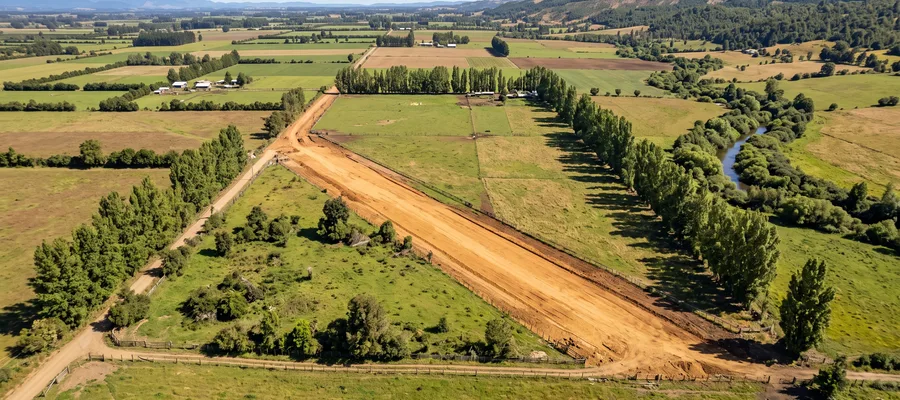
Almost every expropriation is partial. The State rarely needs the whole property: it needs a strip for a road alignment, a corner for an interchange, a band for irrigation works. The rest stays with the owner.
The problem is that a property is not worth the sum of its square metres. It is worth what it can do. Take two hectares off a twenty hectare farm and it is not left worth eighteen twentieths of what it was, if those two hectares were the ones that reached the road, or if the strip splits it into two halves that can no longer be worked together.
The panel's valuation almost always measures what is taken. It rarely measures what happens to what is left. That gap is what opens this route.
Two different requests, not one
The statute provides for two things that are often confused and that have different consequences.
Taking the whole property
This applies where the part not affected by the expropriation lacks economic significance on its own, or where working or exploiting it becomes difficult or practically impossible. If the court grants it, the State takes the whole property and pays for the whole property.
Taking another specified portion
This applies where it is not the whole property that is left unusable but a specific part of it which, as a result of the expropriation, has been left in one of those positions. Here the portion must be properly identified: it is not enough to say the rest was left in a bad way, you have to say which piece and why.
What the court orders, the body has to carry out, and there is a deadline. If the judgment grants either of these requests, the expropriating body must issue the additional or amending expropriation order the court specifies within ninety days of the decision becoming final. If it fails to do so, the expropriation order challenged lapses.
When you can argue that what is left makes no sense
The statute uses two expressions, and they are worth reading separately because they do not ask for the same thing.
Lacking economic significance goes to value. This is the remnant left so small, so badly shaped or so badly placed that it no longer represents any value of its own.
Working or exploiting it becoming difficult or practically impossible goes to use. Here the piece may have enough surface area but cannot be worked: there is no way in, there is no water, it has been cut off from the farmhouse or the sheds, or its shape does not let machinery turn.
These are the situations that repeat in the cases we see.
The deadline, which is where this is lost
Thirty days from publication of the expropriation order in the Diario Oficial. Once that period expires, the right to challenge lapses.
Two things about that calculation. The first is that it does not run from the day you were told or the day the machinery arrived: it runs from publication. The second is that periods of days under the statute are suspended on public holidays, so they are not simply calendar days, but that gives less margin than it seems and the calculation is not one to cut fine.
This challenge does not stop the works. The statute provides that a challenge does not halt the expropriation procedure, except where what is attacked is whether the expropriation is available at all or the terms of payment, and even then only on qualified grounds. Asking for the whole property to be taken does not stop the State taking possession of the strip while the court decides.
How it is proved, because asserting it is not enough
A submission saying the rest of the farm was left useless will not succeed. What decides it is the technical file, and that is built from three things.
A survey of the property before and after, showing the real geometry of what is left: area, shape, access, boundaries and where the strip sits within the whole.
A description of the use it had and the use it can have afterwards. If the property supported a particular activity, you have to show why that activity stops being possible or stops being viable with what remains.
And the real area against the registered one. They frequently fail to match, and when they do not the argument gets muddied: you end up fighting over an area the paperwork does not support.
Does this match your situation?
Ask about my case on WhatsAppThis does not replace the challenge to the amount
They are two separate routes, with separate deadlines, and both can be used.
Partial expropriation is raised within thirty days of publication and argues about what is taken. The challenge to the amount can be brought up to the thirtieth day after physical possession is taken and argues about what is paid.
The order matters. If the court orders the whole property to be taken, what has to be valued changes completely, and the amount is then argued on that new basis. Which is why the decision to seek total expropriation is taken first, and quickly, because its deadline expires much sooner.
What happens if the court refuses
It can happen, and it is worth planning for from the start. If the court takes the view that what is left keeps its economic significance and can still be worked, the owner keeps the remainder.
That does not leave the case without a route. The loss the works inflict on the part not taken is still patrimonial damage actually caused, and as such it belongs in the argument over the amount. A property left cut in two, or one that now needs a new access built, is worth less afterwards than before, and that difference is valued.
Which is why the two routes are prepared together even though they are exercised separately: the same survey and the same expert evidence support the claim for total expropriation and, if that is refused, quantify the loss in the challenge to the amount.
The remainder, afterwards
If you keep the rest of the property, there are three things to put in order that almost nobody does in time.
The registered area
The title still states the original surface. After the expropriation the property is smaller, and that difference does not correct itself. Until it is adjusted, any future transaction carries an inconsistency between the paperwork and the ground, and what is needed is a rectification of area.
Access
If the strip took the entrance, the remainder needs a way out to the public road. It may come within the works project itself, and if not, it has to be created, by agreement with the neighbour or through proceedings. We cover it in the guide to the right of way easement.
The assessment roll and property tax
The property is smaller but the roll is still the same, and so is the rateable value. Correcting it is what stops you paying property tax on metres that are no longer yours, and it is worth doing as soon as the expropriation is registered.
And a warning about subdividing afterwards. If the remainder has been left below the minimum area required by Decree Law 3.516, it cannot be divided or transferred separately unless one of the statutory exceptions applies. Worth knowing before making plans with what is left, and it is developed in the guide to rural land subdivision.
The mistakes that cost you this route
- Waiting to see how it turns out. The deadline is thirty days from publication, and at that point the works have not started. The effect has to be projected on the plan, not verified on the ground.
- Asking without identifying the portion. Where you ask for another part of the property to be taken, you have to say which part and why it was left in that position.
- Confusing this request with the challenge to the amount. They are separate deadlines and they are lost separately.
- Neglecting the title meanwhile. If total expropriation is granted, you have to prove ownership of the whole property in order to collect the compensation, and the title search is what tells you whether that stands up.
How we handle this at Terreno en Regla
The first thing is the date: we locate the publication in the Diario Oficial and work out the expiry, because that determines whether this route is still open.
Then we go to the property. We survey it with our own equipment, draw the strip onto the plan and measure what is left: area, shape, access, buildings and water. That comparison between before and after is the heart of the claim.
If the case holds up, we file the claim before the civil court for the place where the property lies, seeking total expropriation or that of the relevant portion, and run the proceedings through to judgment. If it does not hold up, we say so: better to know before spending on a case that will fail, and to put the effort into the amount instead.
Frequently asked questions
Is there a minimum area below which this applies automatically?
No. The statute sets no figure in metres and no percentage. The test is not how much is left but whether what is left has economic significance on its own, or whether working it has become difficult or practically impossible. Half a hectare with access and water may make sense, and twenty hectares with no way in may not.
If I ask for total expropriation, can they make me keep the rest?
The request is decided by the court, not by the expropriating body. If the judgment grants it, the body must issue the additional or amending order the court specifies within ninety days of the decision becoming final, and if it fails to do so the expropriation order challenged lapses. If the court refuses, you keep the remnant and the argument over the amount remains open.
Do the works stop while the court decides?
No. A challenge does not halt the expropriation procedure, except where what is attacked is whether the expropriation is available at all or the terms of payment, and even then the judge must be satisfied on qualified grounds. In practice the strip is taken and the works advance while the case runs.
I have already drawn the provisional compensation. Can I still ask for total expropriation?
What closes this route is the expiry of the thirty days from publication, not having taken the money. Signing an agreement about the expropriation is a different matter, because an express agreement sets the terms. Before drawing the money or signing anything it is worth checking what is being accepted, and we cover that in the guide on how expropriation compensation is collected.
Tell us your situation and we will tell you what applies.
Talk to a lawyer on WhatsApp