How to calculate the CPI adjustment and the UF value in your property contracts
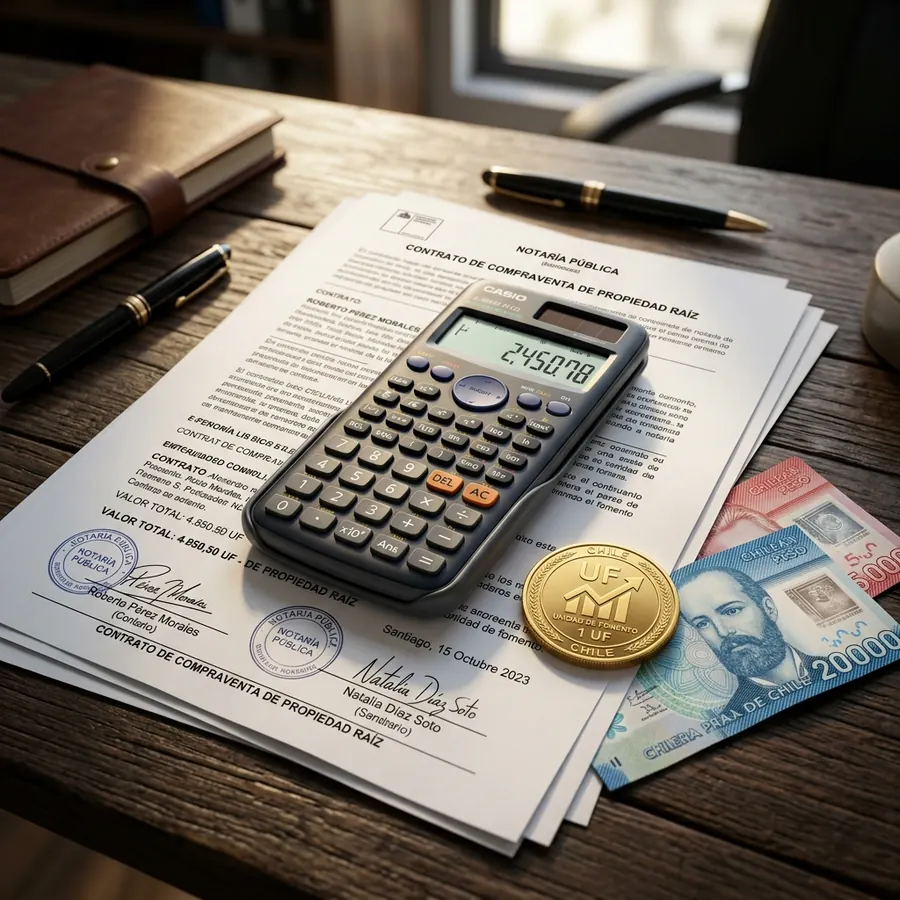
- Why it is vital to calculate the CPI adjustment correctly
- How the UF protects your property investment
- Meet our free financial calculator
- How the UF value is actually built
- Where adjustments break down in practice
- Which property contracts include an adjustment
- Frequently asked questions about adjustments, CPI and UF
- ↳ How often can a lease be adjusted for CPI?
- ↳ What happens if the contract says nothing about adjustment?
- ↳ Is it better to set the rent in UF or in pesos with a CPI adjustment?
- ↳ Who sets the UF value and where can it be checked?
- ↳ What if my tenant does not pay the adjusted amount?
- ↳ Does a mortgage loan in UF work the same as a lease adjustment?
- ↳ What should I check before signing a promise of sale priced in UF?
- Protect the return on your contracts today
- How we work on this
The adjustment is not applied at random month by month: it is calculated on the accumulated variation of the Consumer Price Index (CPI) during the period set by the contract itself, usually six or twelve months, and it only applies if that clause was put in writing. The unidad de fomento (UF) serves a different function, because it expresses the price in a unit that already adjusts itself. Confusing the two mechanisms, or calculating them by hand, is what ends up invalidating charges.
The property market in Chile demands pinpoint financial precision. Whether you are paying the instalment on a plot of land, collecting the monthly rent on your flat or signing a promise of sale, two economic factors set the rules of the game: the UF and the CPI. A simple manual calculation error when applying these indicators can cost you millions of pesos in the long run or legally invalidate your charges.
Why it is vital to calculate the CPI adjustment correctly
Inflation erodes the purchasing power of money month by month. The CPI is the government's official mechanism for measuring that variation. In long-term rental contracts, it is standard practice to include an adjustment clause based on the accumulated CPI variation over six months or a year. If you are a landlord and forget to apply the adjustment, you will lose real returns against inflation. If you are a tenant and the CPI is calculated wrong, you will end up unfairly overpaying.
The problem is that many people try to do this calculation by hand or search for confusing formulas online. Adding monthly percentages together directly is a serious mathematical and legal error that can lead to court disputes over improper charges.
How the UF protects your property investment
The UF, in turn, was created precisely to protect long-term financial transactions against currency devaluation. Today, almost all properties in Chile are sold and valued in UF. Converting UF into Chilean pesos requires knowing the unit's exact value for the specific day of payment, a figure issued daily by the Central Bank.
Agreeing the sale of a plot of land with the amounts set out in UF ensures that the seller will receive the real value agreed, no matter how much inflation rises between the signing of the promise of sale and the final deed. For the buyer, it demands financial discipline to know exactly how many pesos will need to be transferred on the day the deal closes.
Meet our free financial calculator
To remove any margin of error, we have developed free, precise digital tools. Select below whether you need to calculate the CPI adjustment between two dates or simply want to check the exact UF value and other indicators in real time:
These tools connect directly to the servers of the Central Bank of Chile to pull the official values for the day.
You will be able to calculate the exact CPI variation between two dates and get an instant conversion from UF to Chilean pesos or vice versa. No more confusing manual calculations or outdated spreadsheets. With a couple of clicks you will get the exact figure you should charge or pay, backed by the State's official financial data.
How the UF value is actually built
The UF is not recalculated from scratch every day, nor does it depend on the current day's inflation. The Central Bank of Chile sets it in exercise of its Organic Constitutional Law, taking the CPI variation for the calendar month immediately before and spreading it proportionally across the days of the period in which it applies.
That period does not coincide with the calendar month: the UF is adjusted from the tenth day of each month until the ninth day of the following month, and the Central Bank publishes the values in the Diario Oficial (the official gazette) by the ninth day at the latest, that is, before the period even begins to run.
Three consequences follow from that, and they are worth keeping clear when drafting or reviewing a contract. The first is that today's UF value reflects last month's inflation, not today's. The second is that, within each period, the value for every single day is already published in advance: you can calculate exactly how much will be owed on a future date within that window, with no need to estimate. The third is that if a given month's CPI comes out negative, the UF falls during the following period. It is not a value that only ever rises, and a well drafted contract should say what happens in that scenario.
Where adjustments break down in practice
Most adjustment disputes do not come from an arithmetic mistake, but from a clause that left open something that seemed obvious at the time of signing. These are the points that end up being argued over later:
- It does not say which UF value applies. If the contract only states that the rent is a given number of unidades de fomento, the essential part is missing: whether the UF used is the one for the day of payment, the one for the agreed due date, or the one for the last day of the previous month. With late payments, each option produces a different figure.
- It does not define the CPI base month. A clause that refers to an annual adjustment based on the index's variation is useless if it does not state from which month the count starts. Two parties acting in good faith can reach different results under the same clause.
- UF and CPI are combined in the same obligation. Setting the rent in unidades de fomento and adding a CPI adjustment clause on top produces a double adjustment for the same inflation, because the UF already incorporates that variation.
- Negative variation is not addressed. If the index for the period comes out negative and the contract does not regulate that case, the argument begins over whether the rent falls or stays at its previous value.
- The rent is adjusted without a clause allowing it. Applying inflation when the contract is silent is not an adjustment, it is a charge above what was agreed, and it exposes the landlord to having a claim for unpaid rent dismissed.
None of these problems is solved with a calculator. They are solved earlier, in the drafting, which is why reviewing the adjustment clause costs a fraction of what it costs to argue over it afterwards.
Does this match your situation?
Ask about my case on WhatsAppWhich property contracts include an adjustment
CPI adjustment, or pricing in UF, is not exclusive to rental contracts. It appears, with different mechanics, in several of the contracts signed when buying, selling or financing a property. Recognising which one you are dealing with lets you know exactly which clause to check before you sign.
In residential leases, as we saw, the adjustment only operates if the contract expressly agreed to it, with a defined period and base month. In the promise of sale and in the sale itself, the price is usually set directly in unidades de fomento, so a separate adjustment clause is not needed, because protection against inflation is already built into the unit. What does need to be pinned down precisely in that case is which UF value is used for the final payment, because months can pass between the signing of the promise and the signing of the deed. This is especially relevant when buying a new home, where the final price can also be affected by recent regulatory changes, such as those we review in our analysis of zero VAT on new homes.
Mortgage loans follow a logic similar to a sale priced in UF: the outstanding balance and the instalments are expressed in that unit, so each payment adjusts automatically to the UF value for the corresponding day. Anyone financing a home purchase with this kind of loan should understand how that UF denomination works before committing to a monthly amount, something we cover in more detail in our guide on the state guaranteed mortgage loan.
Commercial leases are the area most prone to error, because they often combine rent set in UF with common expenses that sometimes carry their own separate CPI adjustment clause. That is where the double adjustment we explained above shows up most often: charging the CPI variation on top of an amount that is already in UF, a unit that already incorporates that same inflation.
Frequently asked questions about adjustments, CPI and UF
How often can a lease be adjusted for CPI?
As often as the contract itself sets. In residential leases it is usual to agree the adjustment every six or twelve months, applying the index's accumulated variation over that period. The frequency is not imposed by law, so if the contract is silent there is no default rule allowing an adjustment on your own initiative.
What happens if the contract says nothing about adjustment?
The rent stays nominally the same for the whole agreed term. The landlord cannot start charging an adjusted amount by invoking inflation if that clause was never put in writing, and if they do, the tenant can keep paying the original amount without falling into arrears. The chance to fix it comes at renewal or when signing a new contract.
Is it better to set the rent in UF or in pesos with a CPI adjustment?
They are two different mechanisms and both are valid. The UF builds in the adjustment automatically and daily, so the rent's real value is never eroded. Pricing in pesos with a CPI clause concentrates the correction on set dates, which gives the tenant certainty about how much they will pay each month until the next adjustment.
Who sets the UF value and where can it be checked?
The Central Bank of Chile calculates and publishes the daily UF value, and that publication is the official reference for any charge. That is why it matters to use the value for the exact day the contract specifies, usually the payment date or the last day of the previous month, rather than an approximate figure from memory.
What if my tenant does not pay the adjusted amount?
That is a matter of arrears, not a reason to take matters into your own hands. The landlord cannot cut off basic services or take self-help measures to pressure payment, something we cover in depth in our article on cutting off services to a tenant in arrears. The correct route is a court claim for the unpaid rent and, where applicable, eviction proceedings.
Does a mortgage loan in UF work the same as a lease adjustment?
Not exactly. In a lease, the adjustment only operates if the contract expressly agreed to it and it applies on specific dates. In a mortgage loan, the debt is already denominated in UF from the outset, so the adjustment is daily and automatic, with no need for an additional clause. We look at this difference in our guide on the state guaranteed mortgage loan.
What should I check before signing a promise of sale priced in UF?
That it is clear which UF value will be used to calculate the amount in pesos on the day of payment, and that the reference date, whether the signing of the promise, the signing of the deed or the actual day of payment, is written without ambiguity. A prior title study also helps to spot other gaps in the contract before committing to payment.
Protect the return on your contracts today
Having the right figure is only the first step. Real protection for your investment comes from a legally sound contract that clearly sets out how and when these adjustments will apply. A poorly drafted contract can leave legal gaps that stop you from applying inflation in your favour.
How we work on this
At Terreno en Regla we do not calculate the adjustment for you, that is what the Central Bank's tools are for. What our team of lawyers does is review the clause before the dispute exists: we spot whether the CPI base month is missing, whether there is a double adjustment between UF and CPI, or whether the wording leaves open what happens with a negative variation.
This review is especially useful before signing a promise of sale, a long-term lease or a commercial lease with adjustable common expenses. If the contract is already signed and the dispute arose from a charge you consider improper, our civil litigation team assesses the options available.
The first assessment is free. Send us the adjustment clause from your contract, whether a lease, a promise of sale or a mortgage loan, and we will tell you whether it is properly drafted or what it needs to be enforceable.
Tell us your situation and we will tell you what applies.
Talk to a lawyer on WhatsApp