Does this property have water rights? How to check before you buy in Chile
- Two registries with different roles
- Step 1: read the property deed
- Step 2: request certificates from the right Registrar
- Step 3: look up the right in the DGA registry
- Step 4: check what the right says and whether it matches the land
- Step 5: check the non-use fee
- Step 6: look at the basin, not just the property
- Red flags before you sign
- Frequently asked questions
- ↳ Does the DGA's Public Water Registry certificate prove I own the right?
- ↳ Can I look up a property's water rights by its tax roll number?
- ↳ What should I do if the seller says the water comes with the land but the deed does not mention it?
- ↳ How long does it take to review a property's water rights?
- How we can help
"Comes with water rights." The phrase shows up in listings for rural plots, in inheritance conversations and in purchase agreements, almost always without a registration number next to it. Sometimes it is true. Other times the right exists but is in someone else's name, a deceased person's or a former owner's. And often what there is is a well or a canal intake that has been used for years without any title.
Finding out whether a property in Chile has water rights is not done by looking at the well or asking the neighbor. It is done in two public registries, with specific certificates, and by comparing what the documents say with what is on the ground. This guide explains where to look, what to request, how to read what you find and which red flags should make you stop before you sign.
Short answer: water rights are registered in the Water Rights Registry of the Real Estate Registrar for the district where the intake or the well is located, and they must also appear in the Public Water Registry kept by the General Directorate of Water (DGA). The first proves possession; the second does not prove ownership, but without it no procedure can be carried out before the DGA. If the deed for the sale of a property does not mention the rights, the law presumes they are not included.
Two registries with different roles
A water use right is an asset separate from the land, and the law gave it its own registry. Possession of it is acquired by registration in the Water Rights Registry kept by each Real Estate Registrar (Conservador de Bienes Raíces), and it is transferred by a public deed recorded in that same registry. This is the registry that controls: if the right is not registered in the name of the person who claims to hold it, that person cannot transfer it.
The DGA keeps a second registry, the Public Water Registry (Catastro Público de Aguas), which includes a Public Registry of Water Use Rights. It lets the government know who holds which water and where, but the Water Code itself says its records never prove registered possession or ownership. That does not make it irrelevant: a right that is not in the Public Water Registry cannot be the subject of procedures before the DGA, its holder is exposed to a fine and, from April 6, 2032, the Registrar will not record its sale without the Public Water Registry receipt annotated in the margin.
Step 1: read the property deed
The first document to review is the deed by which the current owner acquired the land. Article 317 of the Water Code requires that, when a property is sold, the deed state expressly whether the water use rights are also transferred, and if it does not, they are presumed not to be included.
If the deed mentions the right, it will usually give its registration in the Water Rights Registry, with page, number, year and Registrar. That is the information you need to request the certificates in the next step. If the deed says nothing, there are three possibilities: the right is still in a former owner's name, there never was a registered right, or the water is used without title. All three can be investigated, but none is settled by the seller's word.
Step 2: request certificates from the right Registrar
The Registrar that holds the right is not always the one for the land. Article 118 of the Water Code determines it by the location of the water: it is the one for the district where the intake of the main canal on the natural watercourse is located or, for groundwater, the district where the well is. A property irrigated by a canal that draws water from a river in another district may have its right registered far from where the land is registered.
Two documents are requested from that Registrar. The copy of the Water Rights Registry entry with a certificate of good standing, which shows whose name the right is in today, and the certificate of mortgages, liens and prohibitions from the same registry, which shows whether the right is mortgaged, attached or subject to a ban on sale. To request them you need the page, number and year of the registration. The exact names of the certificates vary from one Registrar to another, but that is their content.
The copy with good standing lets you check three things: that the registered holder is the seller or the deceased, that the registration has no margin notes of later transfers, and that the right described corresponds to the property under review. If the Registrar objects to a registration, there are ways to challenge it, which we explain in our guide on what to do when the Registrar rejects a registration.
Step 3: look up the right in the DGA registry
The DGA publishes the Public Registry of Water Use Rights on its website, as regional spreadsheets plus a consolidated national one. Each row is a right and includes, among other data, the holder's name, the district, the coordinates of the point of extraction, the Registrar and the page, number and year of the registration.
Two things are worth knowing before you search. First, the spreadsheets have no column for the property's tax roll number, so you search by holder name, district or registration details, not by roll number. Second, the DGA itself warns that the registry does not prove that ownership is current: for that you have to go to the Registrar. The Public Water Registry is useful for something else. If the right does not appear, the holder has a pending step that, for rights registered with the Registrar, must be completed before April 6, 2032.
Does this match your situation?
Ask about my case on WhatsAppStep 4: check what the right says and whether it matches the land
A registered right is not just a name and a number. Its registration describes its characteristics, and those are what tell you whether the right serves your purpose. The main ones are:
- Consumptive or non-consumptive. A consumptive right allows the water to be used up, as in irrigation or household use. A non-consumptive right requires returning it to the watercourse, as in a hydroelectric plant. For a rural plot, you almost always want the first.
- Permanent or contingent. A permanent right entitles you to water under normal conditions. A contingent (eventual) right is only exercised when there is surplus, after permanent rights are met, and in dry years it may yield nothing.
- Continuous, discontinuous or alternating. This defines whether the water can be used without interruption, only during certain periods or in turns with other users.
- Flow and source. How many liters per second and from where: a river, a stream, a spring or an aquifer.
- Point of extraction. The registration must state the intake or point of extraction in UTM coordinates.
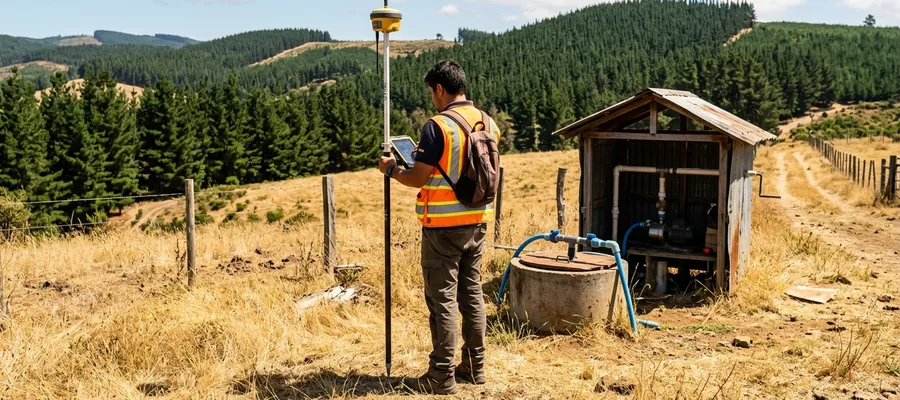
That last item is the one that brings the most surprises. The well or intake in use today may not be where the registration says, because it was moved without authorization or because the old coordinates were imprecise. Changing the point of extraction requires authorization from the DGA, and to apply, the right must have its final certificate from the Public Water Registry. In our reviews, the surveyors on our team measure the actual point on site and we compare it with the registered one before you sign.
Step 5: check the non-use fee
Rights that are not used pay a non-use fee (patente por no uso). Every year, in mid-January, the DGA publishes the list of affected rights, and the fee is paid in March. If it is not paid, the right can end up auctioned by a court. And if the right remains unused, once the legal periods pass it is extinguished in whole or in part: five years for consumptive rights and ten for non-consumptive ones, counted from their first inclusion on the list.
For rights that predate the 2022 reform and appear on those lists, the DGA has instructed that the period be counted from January 16, 2023. This means an old consumptive right that is on the list and not used could be extinguished on January 16, 2028. So before buying a right or a property with water, it is wise to check the fee lists for recent years and ask for proof of payment.
Step 6: look at the basin, not just the property
If the property has no rights and the plan is to apply for a new one, the question stops being legal and becomes hydrological: whether water is available at that source. In groundwater prohibition zones and restriction areas, the DGA does not grant new groundwater rights or limits them, and there the only possible water is water that already has a granted right. We explain this in detail in our guide to buying land with water rights.
Red flags before you sign
- The right is registered in the name of a deceased person. The probate and the inheritance registration are missing; we explain this in our guide to inheriting water rights.
- There is only a DGA resolution, with no registration at the Registrar. That right lapses if it is not registered before April 6, 2032; see our guide on the 2032 deadline.
- There is only a well. It may be enough for domestic subsistence use, but not for commercial irrigation or rental cabins; see our guide on wells without water rights.
- Water arrives through a canal and the seller has no individual title in the water community.
- The right does not appear in the DGA's Public Water Registry or is on the non-use fee list.
- The registered coordinates do not match the well or intake in use.
None of these red flags necessarily rules out the purchase. But all of them must be resolved before you pay, or be addressed in writing in the deed, with someone responsible and a deadline.
Frequently asked questions
Does the DGA's Public Water Registry certificate prove I own the right?
No. The Water Code expressly says the Public Water Registry records do not prove registered possession or ownership. What proves who holds the right is the registration in the Registrar's Water Rights Registry, with a certificate of good standing.
Can I look up a property's water rights by its tax roll number?
Not in the DGA's public registry, which is searched by holder, district or registration details. At the Registrar you need the page, number and year. If you do not have them, the starting point is the property deed or information from the previous owner.
What should I do if the seller says the water comes with the land but the deed does not mention it?
Ask for the registration details of the right and verify them before signing. If the right exists and is in the seller's name, the purchase deed must include it expressly. If it does not mention it, the law presumes the water was not sold.
How long does it take to review a property's water rights?
It depends on whether registration details exist and on which Registrar the certificates must come from. With the page, number and year, the review moves quickly; without them, the history of the right first has to be rebuilt from earlier deeds.
How we can help
At Terreno en Regla we review a property's water rights before you buy, sell or inherit: we request the certificates from the correct Registrar, cross-check the information against the Public Water Registry and the non-use fee lists, and our surveyors verify the point of extraction on site. You can see how we work on our water rights and title search pages.
Tell us your situation and we will tell you what applies.
Talk to a lawyer on WhatsApp