Why shares and rights no longer get registered: article 15 and the remaining options
- What they are really looking at
- Why the notary will not sign either
- I already bought it and it was not registered. What do I actually have?
- The different case: you did manage to register
- The real options
- If you were rejected recently, check the date
- Frequently asked questions
- ↳ Can I buy rights together with someone else to live together?
- ↳ Does it help to also sign a private contract with the lot plan attached?
- ↳ What if we use a notary in another city?
- ↳ The seller tells me everything will be regularised later. Should I believe it?
- ↳ Can I build in the meantime?
- ↳ How long does it take to get out of this?
- ↳ Is it worth buying shares and rights today?
- How we handle it
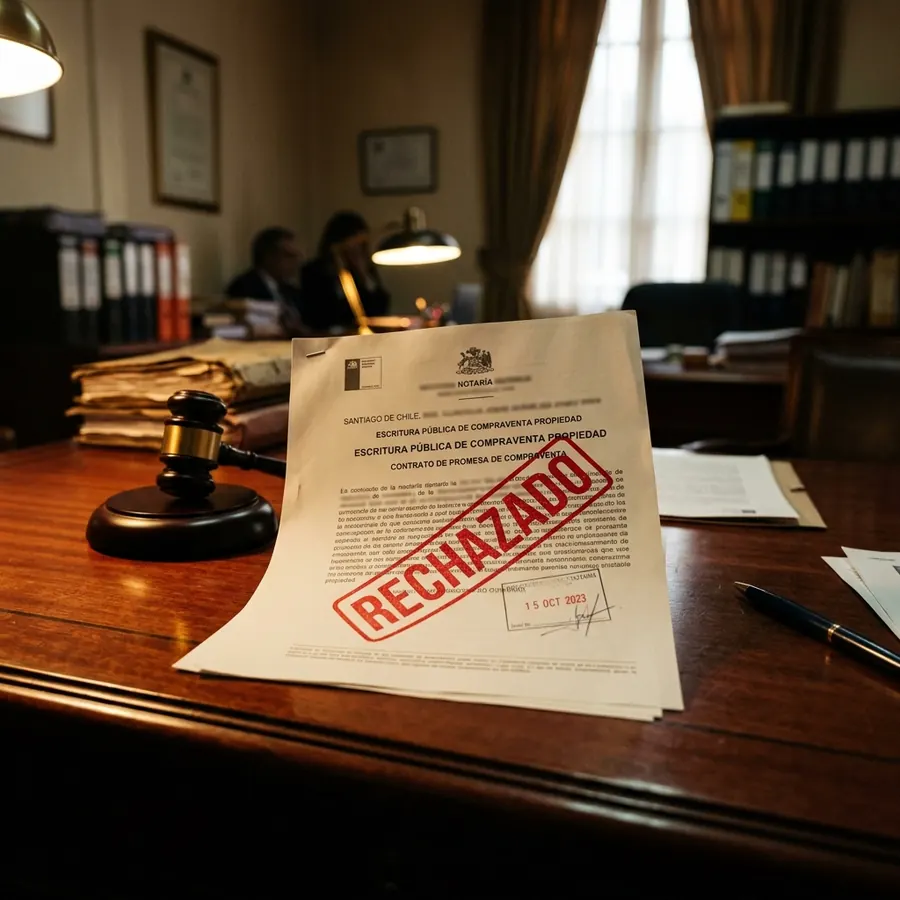
Quick answer: this is not a whim of the Conservador de Bienes Raíces (the Chilean property registry) or ill will on the part of the notary. Article 15 of law 20.234, incorporated by law 21.477, bars notaries from authorising and Conservadores from registering titles that directly or indirectly could involve the formation of a new settlement, neighbourhood, loteo (an unauthorised land subdivision) or subdivision without meeting the urbanisation requirements. Selling a share in a parcel so the buyer can occupy a specific plot is exactly that. The Supreme Court has confirmed that a refusal is lawful whenever the record does not rule out an irregular loteo.
That is why the same paperwork that used to be finished in an afternoon ten years ago now gets turned away at the counter. The Civil Code has not changed. What changed is the rule that tells the notary and the Conservador that they have to look at what is behind the contract.
What they are really looking at
Selling shares and rights in an undivided estate is perfectly lawful in the abstract: whoever owns a share in a property can transfer it. The problem is not the share. It is what the share is being used to do.
The giveaway. When the deed, the accompanying plan or the marketing of the project shows numbered lots, streets, passages or internal boundaries, there is no longer a community. There is a loteo. And at that point the title will not be registered no matter how the wording is reworked.
Why the notary will not sign either
The article 15 prohibition covers both of them. The notary cannot authorise the deed and the Conservador cannot register it, so trying another notary's office is pointless. The problem is not who signs, but what the transaction actually contains.
In practice, standards also vary between Conservadores. Some ask for a certificate of prior planning information from the municipality, others require evidence that rules out a loteo, and others apply a stricter standard depending on the region. That is why the same type of transaction goes through in one place and not in another, and it does not mean the one who rejected it got it wrong.
I already bought it and it was not registered. What do I actually have?
This is the question we hear most, and the answer is uncomfortable: you have a contract, not title. The sale exists and it binds the seller, but until there is registration there was no conveyance, and without conveyance you own nothing as far as third parties are concerned.
- You cannot sell what you occupy, because nothing is on record in your name.
- You cannot mortgage or borrow against that plot.
- You cannot regularise anything you build, because the Municipal Building Department requires title and you do not have it.
- You are exposed to the seller's creditors, since the seller can still appear as the owner of the whole parcel.
- The problem gets inherited, and it becomes harder to untangle with every generation.
You do have claims against the seller, and they carry their own time limits. It is a civil dispute best raised early, especially while the seller is still solvent or still holds registered title to the larger parcel.
The different case: you did manage to register
Many buyers did manage to register their share, especially before the standard was tightened. They are better off, but their situation is not resolved: they are co-owners of a large parcel, not owners of a lot.
That means your registration shows a percentage of the whole, not the square metres you occupy, and that reaching title of your own means leaving the co-ownership. The available routes are set out in our guide to shares and rights, and the main one is partition proceedings.
Does this match your situation?
Ask about my case on WhatsAppThe real options
Which one applies is not decided by reading a single article. It is decided by looking at the registration of the larger parcel, how many occupants there are, since when, and what the municipality's planning instrument says.
If you were rejected recently, check the date
Even when the Conservador rejects a title, it stays noted in the Repertorio, and that entry lasts two months. If the objection can be fixed, correcting it within that period keeps your priority. How that clock works and when a refusal can be challenged is covered in our guide to Conservador rejections.
That said, it is worth being honest: when the objection is that the transaction amounts to a loteo, it is not the kind of thing a certificate can fix. In that case the route is a different one, and the deadline changes nothing.
Frequently asked questions
Can I buy rights together with someone else to live together?
This is the case most likely to be accepted, especially between spouses, civil partners or close relatives, and several Conservadores assess it case by case. What you need to be clear about is that afterwards you cannot divide the parcel between the two of you by agreement alone, unless it meets whatever subdivision rules apply.
Does it help to also sign a private contract with the lot plan attached?
That document does not give you title and, worse, it is proof that the transaction was a disguised subdivision. It is exactly the kind of evidence the Conservador uses to justify a rejection.
What if we use a notary in another city?
The prohibition is a matter of law and applies equally to notaries and Conservadores everywhere. Changing offices does not change the transaction. And even if it were somehow authorised, registration remains the obstacle, because a property is registered where it is located.
The seller tells me everything will be regularised later. Should I believe it?
Ask for that promise in writing, with a deadline and the specific route the seller intends to use, and check whether that route actually exists for that parcel. In most of the irregular loteos we have seen, that promise was never kept because it was never possible.
Can I build in the meantime?
You can build de facto, and many people do, but you will not be able to obtain final approval or a building permit without title, and you are exposed to fines from the Municipal Building Department. It is an investment that afterwards cannot be sold or mortgaged.
How long does it take to get out of this?
It depends on the route and on how many occupants there are. A partition among a handful of co-owners is one thing. Regularising a loteo with dozens of families is a long project, and one that is better handled jointly, because the cost per property drops significantly.
Is it worth buying shares and rights today?
If what you are being offered is a share to occupy a specific plot, no. That is exactly the transaction the law was written to stop, and the buyer is always the one left holding the problem. If it is genuine co-ownership, with no allocation of individual lots, that is a different matter and needs to be reviewed case by case.
How we handle it
The first step is reading the registration of the larger parcel and seeing how many shares were transferred, to whom, and since when. That tells us immediately whether we are looking at genuine co-ownership or a de facto loteo, and everything else depends on that.
We then check whether the settlement qualifies for regularisation under law 20.234, the route designed for these cases, or whether partition is the better fit. When several people are affected, applying together is the most sensible approach, because the fieldwork and the dealings with the State are done once for everyone.
Our own surveying team handles the survey and the plans, and we run the registry side through our title study and regularisation of title services. If the seller needs to be sued, that falls to our litigation team.
Send us the deed you signed and the property's tax roll number, and we will tell you exactly what you have today, whether the rejection could have been fixed, and which of these options applies to your case.
Tell us your situation and we will tell you what applies.
Talk to a lawyer on WhatsApp