Conservator rejects registration of shares and rights: what to do
- Why do notaries no longer sign these deeds
- The final wall: why the Real Estate Conservator refuses to register
- The legal limbo: what happens if my shares and rights did manage to get registered
- Frequently asked questions about the rejection of rights
- ↳ What do I do if I already paid the seller and the conservator rejected my registration
- ↳ If I have my rights registered six years ago, can I regularize to have my own roll
- ↳ Can I transfer my registered rights to a child
- Do not get trapped in an irregular community
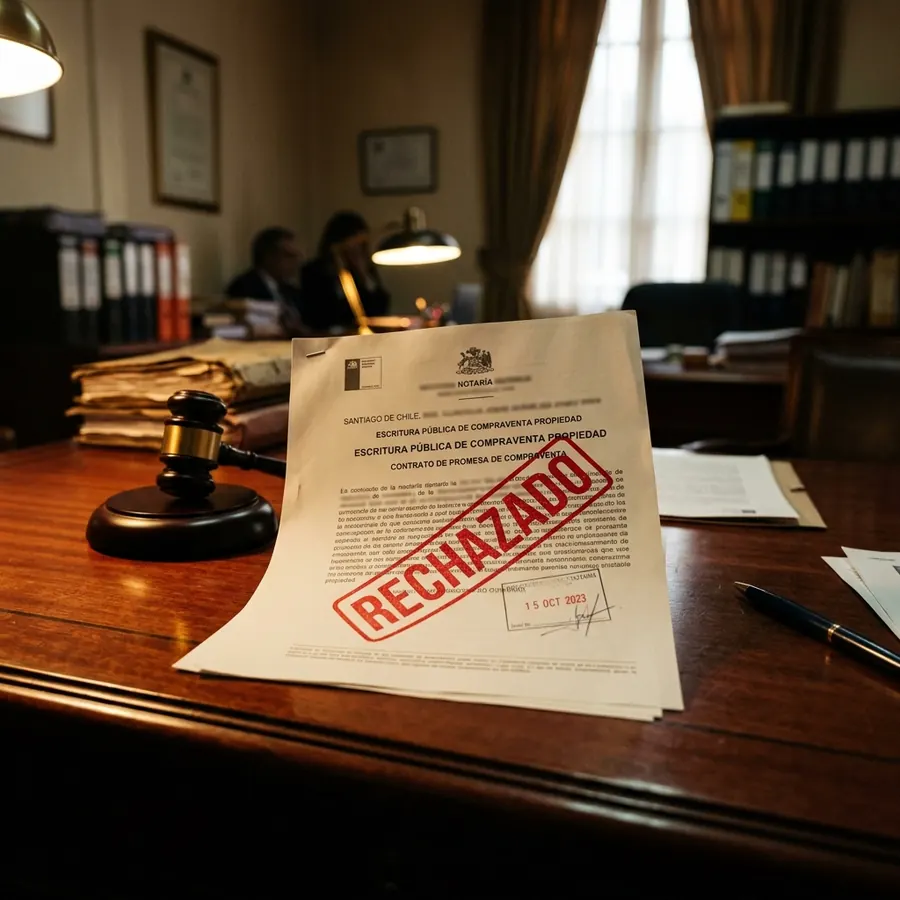
Imagine the following scene. You arrive at the notary office with the seller of that longed for land in the countryside. You have the draft of the purchase and sale of shares and rights ready to sign, the money is on the table, but suddenly the notary reads the document and flatly refuses to authorize the deed. Or worse, you manage to sign, pay the full price and, months later, it is the Real Estate Conservator who stamps a red seal rejecting the registration of your property. Frustration and the fear of having lost your savings take over.
You should know that this is not a whim of the official on duty, nor an excess of bureaucracy. It is a strict and coordinated instruction from the Supreme Court, the Ministry of Housing and Urbanism, and the Ministry of Agriculture. The objective is to put a complete stop to the crime of irregular subdivisions that is destroying rural land. Below, we explain the legal war that has forever changed the way of buying land in Chile.
Why do notaries no longer sign these deeds
Historically, notaries limited themselves to certifying the signatures of the parties, but today they have assumed an active and rigorous preventive role. Let us clarify a fundamental point: selling shares and rights over land is a completely legal concept in civil theory. However, the Courts of Appeals and the Supreme Court have strictly instructed notaries that they must refrain from authorizing any deed that conceals an illegal material subdivision, that is, sales that seek to create lots smaller than five thousand square meters in rural areas.
The key to this prohibition lies in article one hundred and thirty six of the General Law of Urbanism and Constructions. If the notary detects that one percent of an immense agricultural land is being sold so that a person can install their house, the law assumes that a new urban nucleus is being formed outside all legality. If the notary decides to authorize that sale, they automatically become an accomplice to a crime punishable by jail time. That is why today they prefer to reject the deed rather than risk their career.
The final wall: why the Real Estate Conservator refuses to register
If by some miracle or error you managed to get past the notary, you will face the true guardian of property: the Real Estate Conservator. This official has the so called qualification faculty, enshrined in article thirteen of the Conservatory Registry Regulation. This rule grants them the absolute power to refuse to register a title if it is visibly null due to containing some insurmountable defect.
Today, Conservators assume as an unavoidable legal presumption that massive sales of small percentages are a fraudulent simulation. For example, selling two percent of a plot to fifty different people is considered a clumsy attempt to evade decree law three thousand five hundred and sixteen. Various circulars issued by the Agricultural and Livestock Service and the Ministry of Housing have ordered Conservators to immediately paralyze these registrations. The purpose is to stop the incalculable territorial and ecological damage generated by clandestine rural condominiums by saturating water and road resources.
Does this match your situation?
Ask about my case on WhatsAppThe legal limbo: what happens if my shares and rights did manage to get registered
There is a particular situation that affects thousands of Chileans who bought their land years ago, long before this institutional lock was established. If you are one of them and have your registration of rights duly noted in the property registry, we have good and bad news for you.
The good news is that Chilean law enshrines the principle of non retroactivity and respect for acquired rights. Your registration is perfectly valid and the Conservator does not have the legal power to delete or cancel it ex officio. Legally, you are the legitimate owner of a percentage or quota within that large community.
The harsh reality is that, despite being registered, you are still not the exclusive owner of a specific physical lot. You are trapped in a community and suffer very serious practical problems. For example, you cannot request Building Permits from the Municipal Works Directorate, the bank will never grant you a mortgage loan to build, and you suffer the constant risk of a joint embargo if another community member incurs debts. Furthermore, it is impossible to formally separate the electricity connection or the drinking water network, since for the State the matrix remains a single undivided property.
Frequently asked questions about the rejection of rights
What do I do if I already paid the seller and the conservator rejected my registration
There are three legal options. First, if the rejection is due to a minor formal error, you can correct the deed through a rectifying deed. Second, if you consider that the rejection is unjustified, your lawyer can file a claim of refusal before the civil judge on duty to force the Conservator to register. Third, and most common in the face of irregular subdivisions, is to sue for the resolution of the contract due to illicit object, demanding the full return of the money paid plus the corresponding compensation.
If I have my rights registered six years ago, can I regularize to have my own roll
Yes, and this is your golden opportunity. If you comply with more than five years of uninterrupted and peaceful material possession, you can avail yourself of the regularization of small real estate property through decree law two thousand six hundred and ninety five before the Ministry of National Assets. This procedure will erase your old status as a community member and grant you an exclusive title deed and your own roll, making you independent forever from the rest.
Can I transfer my registered rights to a child
Technically it is possible to carry out an assignment of rights or a donation, but you will immediately face the harsh current scrutiny of the notary and the Conservator. There is a very high probability that the procedure will be rejected on the suspicion that you are contributing to the formation of an irregular subdivision, leaving you involved in endless bureaucratic attrition.
Do not get trapped in an irregular community
In summary, the era of easy and uncontrolled irregular subdivisions has definitively ended in Chile. Buying rights today is equivalent to playing Russian roulette with your life savings. On the other hand, if you already have your rights registered, it is imperative that you take immediate legal action to transform them into a real and exclusive property, before the regulations become even more restrictive.
At terrenoenregla.cl we are the insurmountable barrier between you and an irreversible financial disaster. If you are about to buy, we carry out an exhaustive prior Title Study to ensure that you will not suffer rejections or lose your money. And if you are already trapped with your registered rights and long to finally have your own Roll and total independence, our team of experts will process your complete legal regularization from beginning to end.
Tell us your situation and we will tell you what applies.
Talk to a lawyer on WhatsApp