Can I build cabins or run a tourism business on a 5,000 m² plot in Chile?
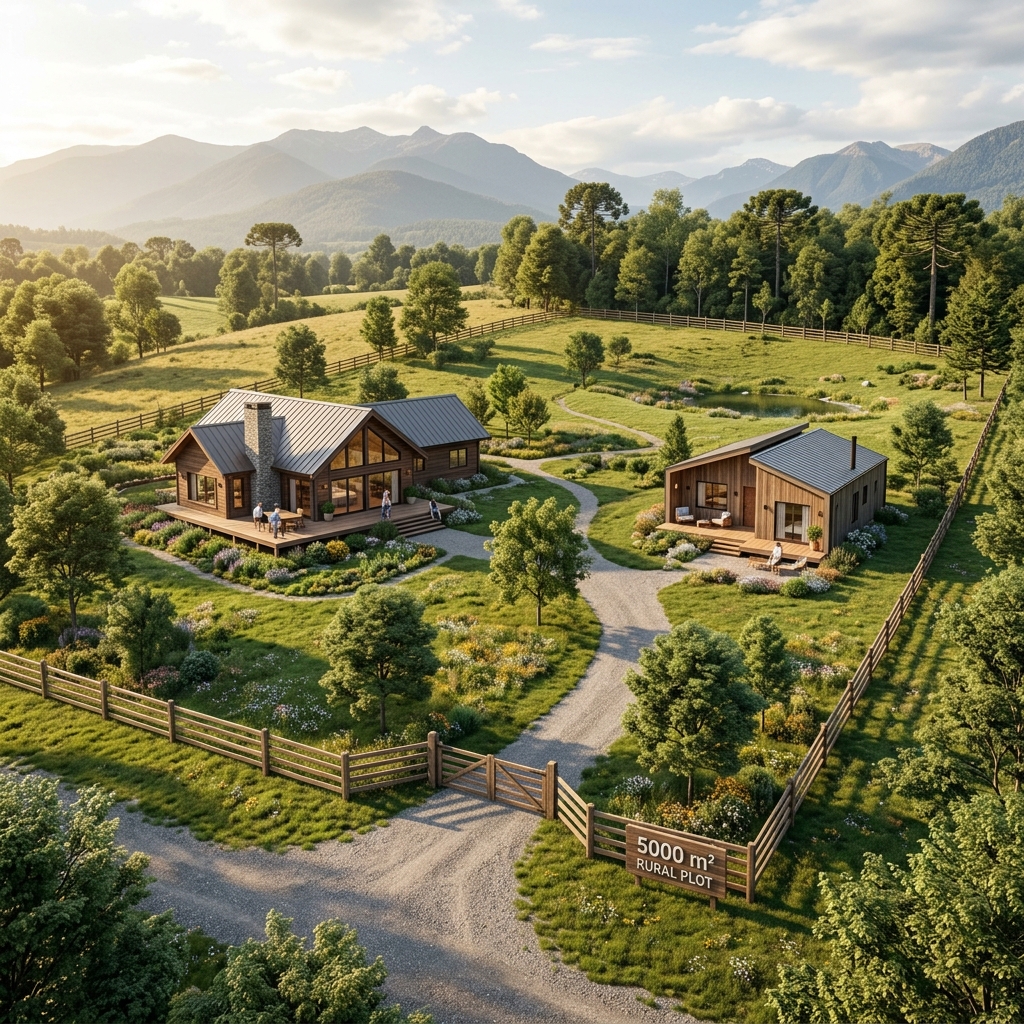
- The original misunderstanding: living on the land is not exploiting it
- Article 55: the legal gateway for rural tourism
- The two permits almost nobody tells apart
- The commercial licence and the SERNATUR registry
- What if I only rent out my house for the season?
- What you risk by starting in the wrong order
- Summary table of procedures
- How we help at Terreno en Regla
- Frequently asked questions
- ↳ How many cabins can I build on 5,000 m²?
- ↳ How long does a change of land use take?
- ↳ Can I rent out my country house on Airbnb?
- ↳ Will my property tax rise if I change the use?
- ↳ I already built the cabins without a permit, what now?
The original misunderstanding: living on the land is not exploiting it
Most of the disputes that reach our firm start from the same misunderstanding. The buyer of a country plot assumes that if the law allowed them to build a house on the property, it also allows them to put up three cabins and rent them out by the season. These are legally distinct situations, and the difference lies not in the size of the land or of the building, but in the designated use of the property.
A rural property located outside the urban boundary retains, as a general rule, its agricultural, livestock or forestry vocation. The rules exceptionally allow buildings necessary for working the land, along with housing for the owner and their workers. That is the permit which covers the family home. A cabin complex, a campsite, a rural inn or an events venue, by contrast, are tourism facilities, that is to say an economic activity outside the agricultural purpose. And any use alien to agriculture in a rural area requires prior and express State authorisation before a single cubic metre of earth is moved.
This is the same distinction that explains why rural land cannot be freely densified. If your prior question is how many buildings the property will take, see our analysis on how many houses can be built on a 5,000 m² plot, because the answer directly conditions whether the tourism project is viable at all.
Article 55: the legal gateway for rural tourism
Article 55 of the General Law on Urban Planning and Construction governs everything that happens outside the urban boundary. Its general rule is prohibitive: opening streets, subdividing to form settlements and erecting buildings in a rural area are not permitted. Yet the same article contains the escape valve that makes tourism in the countryside possible, by exceptionally authorising buildings intended as facilities, industry, or the development of beach resorts and tourist campsites.
That exceptional authorisation is not granted by the municipality. It is issued by the Regional Ministerial Secretariat of Agriculture, following a technical report from the Agriculture and Livestock Service on soil quality and the compatibility of the new use with its surroundings. Where the project involves developing a beach resort or tourist campsite, a favourable opinion from the Regional Ministerial Secretariat of Housing and Urban Planning is also required, with the declared purpose of preventing tourism projects from creating an irregular urban nucleus with no drinking water, sewerage or road infrastructure.
That dual control explains most refusals. The authority does not assess whether the project is profitable or attractive: it assesses whether productive soil capacity is being sacrificed, and whether the project places urban pressure on territory that lacks the infrastructure to absorb it. In recent years the criteria have tightened markedly, in line with what we have documented regarding the new SAG rules and the refusal of subdivisions.
The two permits almost nobody tells apart
There are two authorisations that are commonly confused and that operate on different planes. The first concerns the land and answers the question of what may be done there; it is the change of land use and it is processed before the regional agricultural authority. The second concerns the works and answers the question of how you may build; it is the building permit and it is issued by the Municipal Works Department of the commune.
The order is not negotiable. The Municipal Works Department has no power to authorise a tourism building in a rural area while the prior decision of the agricultural authority is missing, so the municipal file is either rejected outright or left suspended. The central technical input at that first stage is the Feasibility Report for Non-Agricultural Buildings in Rural Areas, known in practice as the IFC, which analyses the soil use capacity and how coherent the project is with the surrounding territory.
Preparing that file properly requires a reliable topographic survey, with areas, boundaries, slopes, watercourses and access roads correctly represented. A deficient plan is a routine source of observations that delay the process by months, which is why we handle these projects together with our surveying and architecture department.
The commercial licence and the SERNATUR registry
Many owners discover the problem only when they apply for the commercial licence. Before granting it, the municipality asks its own Works Department whether the land use of the property admits the declared activity and whether the building has final approval. If the property is recorded as agricultural, or the cabins have no final approval, the licence is refused even if the business is already running with bookings taken.
On top of that sits a sector-specific requirement that is frequently overlooked. Tourist accommodation services must register in the National Registry of Tourism Service Providers, a free online procedure set out in the official guidance on registering as a tourism service provider. That registration presupposes a tax start-of-activities filing with the Internal Revenue Service and a valid municipal licence, so the chain always returns to the same first link: land use.
The tax effect is worth anticipating too. A property that ceases to be agricultural and moves to a commercial designation changes category in the fiscal valuation, which normally translates into a significant rise in property tax. Furnished letting also receives different tax treatment from plain residential letting, with value added tax implications that should be assessed case by case before the business is structured.
Does this match your situation?
Ask about my case on WhatsAppWhat if I only rent out my house for the season?
This is the grey area we are asked about most, and it deserves an honest answer. Occasionally renting out the family home that does hold a permit and final approval is a factual situation that municipalities treat with widely varying criteria, and which in practice rarely triggers an inspection so long as there is no advertising as an establishment, no sign at the entrance, and no neighbour complaints about noise, traffic or rubbish.
The line is crossed once the features of a business operation appear: several housing units built specifically for letting, associated services such as catering, a pool or events, hired staff, and a permanent public offering. At that point it is no longer a rented home but tourism facilities operating without authorised land use, and the risk becomes concrete.
Our practical recommendation is straightforward. If the project involves building in order to let, the correct route is to obtain the permits from the outset, because regularising afterwards is invariably more expensive, slower and far less predictable in its outcome.
What you risk by starting in the wrong order
Building first and asking later carries costs far beyond the price of the permits. The Municipal Works Department can impose fines for works carried out without a permit, order the site to be halted, and even order demolition where the use is definitively incompatible with the land. The municipality, for its part, can close down an establishment operating without a licence.
There is also a quiet but severe effect on your assets. A cabin without final approval cannot be sold with a mortgage, because the bank and its valuer require everything built to be regularised first. The asset is frozen and its market value falls. We have developed these two risks separately in our articles on the time limits on fines for building without a permit and on final approval and the ley del mono.
Summary table of procedures
| What you want to do | Change of land use needed? | Deciding body | Final document |
|---|---|---|---|
| Own home to live on the plot | No, it is the owner's dwelling | Municipal Works Department | Permit and final approval |
| Store or shed for farming the land | No, it serves the agricultural purpose | Municipal Works Department | Building permit |
| Cabins for tourist letting | Yes, a use alien to agriculture | Agriculture SEREMI with SAG report | Change of use resolution |
| Campsite or developed beach resort | Yes, with an added requirement | Agriculture SEREMI and Housing SEREMI | Authorisation with favourable opinion |
| Operate the accommodation commercially | Requires land use already authorised | Municipality, tax service and SERNATUR | Licence and registry entry |
How we help at Terreno en Regla
A tourism project in a rural area demands that the legal and technical fronts be coordinated in parallel, and that is precisely the work we take on. We assess real feasibility before you commit capital, prepare the change of land use file with the report and plans the agricultural authority requires, and act as your representatives before the SAG, the relevant Regional Ministerial Secretariat and the Municipal Works Department until final approval is obtained.
As a preliminary step we always recommend a title study of the property, because ownership restrictions, easements and registered prohibitions tend to be the obstacle nobody checked and that surfaces once the project is already under way. If the plot also comes from a recent subdivision, it is worth verifying that the process complied with the rules in force, a matter we cover in detail in our guide to the Sabag Law and the subdivision of rural estates.
Frequently asked questions
How many cabins can I build on 5,000 m²?
How long does a change of land use take?
Can I rent out my country house on Airbnb?
Will my property tax rise if I change the use?
I already built the cabins without a permit, what now?
Tell us your situation and we will tell you what applies.
Talk to a lawyer on WhatsApp