History of the Sabag law (law 19.807): origin and legal procedure
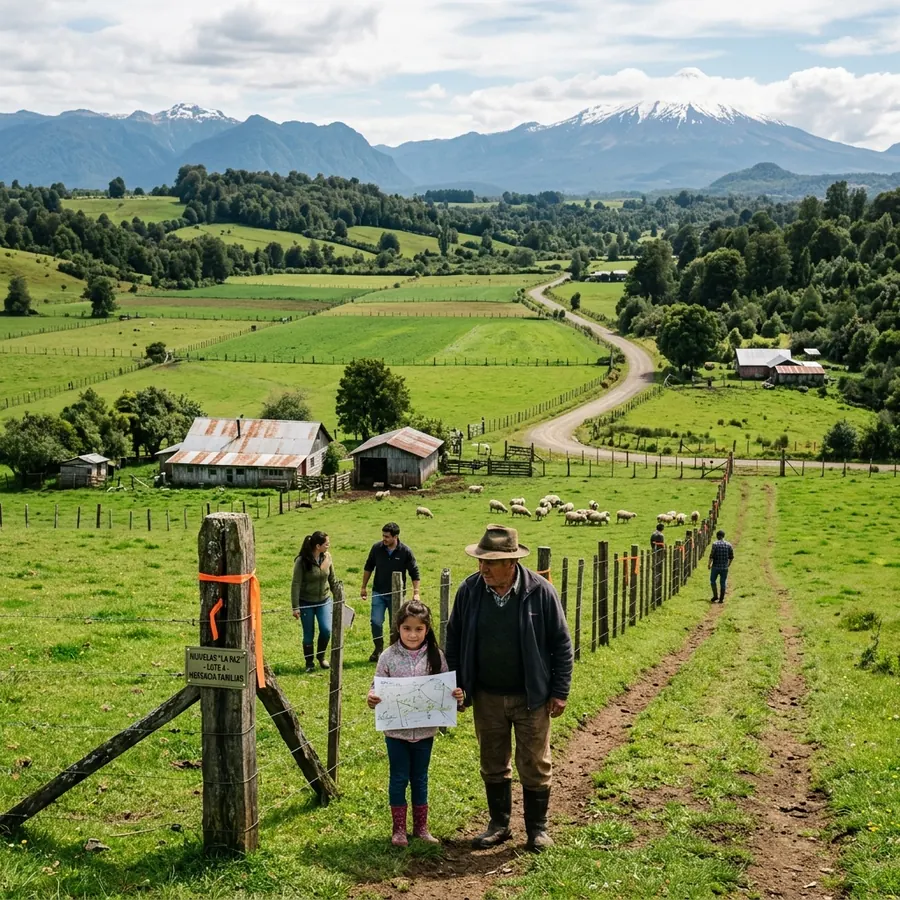
- Origin and enactment: the birth of law 19.807
- The legal exceptions introduced to d.l. 3516
- Social and patrimonial importance of the regulation
- Technical and legal procedure: how to process the subdivision under the Sabag law
- ↳ Phase 1: topographic survey and planimetry
- ↳ Phase 2: preparation of the file and review
- ↳ Phase 3: assignment of rolls (SII)
- ↳ Phase 4: legal perfection
- Entrust your family's history to true experts
- ↳ Do you want to know if you meet the requirements?
The regulatory framework of Chilean real estate is characterized by its rigid defense of arable land, seeking to prevent the fragmentation of rural estates and the proliferation of unregulated subdivisions. However, the strict rule of decree law 3516 presented serious social problems until the enactment of law 19.807, popularly known as the "Sabag law".
Origin and enactment: the birth of law 19.807
Before 2002, peasant families in Chile faced an insurmountable legal dilemma. The d.l. 3516 of 1980 categorically established that rural properties could not be subdivided into lots smaller than 5,000 square meters (half a hectare). This restriction, although intended to protect agricultural productivity, collided head-on with a dramatic social reality: small rural landowners could not legally deliver a piece of land to their children so they could build their own homes.
In this scenario of rural uprooting, senator Hosain Sabag sponsored a bill that sought to humanize rural legislation. Following intense parliamentary debates regarding the balance between protecting agricultural soil and guaranteeing the right to housing, law 19.807 was enacted and published in the Official Gazette in 2002. This historic milestone marked a paradigm shift in Chilean agrarian law.
The legal exceptions introduced to d.l. 3516
Specifically, law 19.807 introduced exhaustive and strictly defined exceptions to article 1 of d.l. 3516. In doing so, it allowed for the first time, legally and regulated, to pierce the unbreakable limit of 5,000 square meters, establishing two major avenues of exception:
- Family transfer: The subdivision and subsequent transfer of lots to ascendants and descendants of the owner was authorized, covering both the line of consanguinity and affinity. The exclusive objective of this transfer must be the construction of housing for these relatives, and the legislator limited the size of the resulting lot to a strict range: it cannot be less than 500 square meters or more than 1,000 square meters.
- Institutional and community transfer: The second exception allows the free transfer to legal entities of public law or non-profit private law foundations and corporations. The legal purpose in this scenario is the construction of infrastructure of evident community benefit, such as schools, chapels, rural health posts, social headquarters, neighborhood councils, and sports facilities.
Social and patrimonial importance of the regulation
Today, the analysis of the Sabag law forces us to recognize it as an indisputable pillar of modern agrarian and patrimonial law in Chile. Its impact transcends the mere modification of square footage; it stands as an active tool that directly combats rural poverty and curbs the depopulation of the Chilean countryside.
One of its greatest patrimonial achievements is the promotion of regularization. By offering an accessible legal route, it prevents families from falling into dangerous and precarious informal "transfers of rights". Delivering a piece of land under this law means providing the relative with an exclusive and independent appraisal roll (Rol de Avalúo), granting them absolute legal certainty over their portion of land.
Furthermore, this independent roll is the master key to social development: it allows access to state housing subsidies (such as those provided by MINVU) and the formal installation of basic services. Simultaneously, the law was drafted with brilliant legal padlocks to protect agricultural lands: it imposes the legal restriction of not being able to sell (alienate) the subdivided piece to third parties outside the family for a period of 5 years. This safeguard is crucial, as it prevents the rule from being used in bad faith to justify illegal plotting or covert real estate developments.
Does this match your situation?
Ask about my case on WhatsAppTechnical and legal procedure: how to process the subdivision under the Sabag law
Despite its noble intentions, availing oneself of the benefits of this regulation is not a simple counter procedure. It is a highly complex procedural, technical, and legal process that requires the intervention of synchronized specialists. Below, we detail the rigorous step-by-step:
Phase 1: topographic survey and planimetry
The process is born on the ground. The preparation of highly precise technical topographic plans is required, complying with the strict current requirements of the Agricultural and Livestock Service (SAG). This implies the georeferencing of the parent property and the lot to be subdivided under the SIRGAS coordinate system, ensuring the millimetric delimitation of the permitted legal range (between 500 and 1,000 m²) and obtaining feasibility certificates.
Phase 2: preparation of the file and review
Subsequently, the legal and technical team compiles the file. Due to current regulations, the technical processing requires the mandatory participation of authorized third party professionals who act as ministers of faith in the planimetric review. Finally, the file is formally submitted to the SAG, and the certificates issued by the Civil Registry that prove the bond of consanguinity or affinity required by the law must inevitably be attached.
Phase 3: assignment of rolls (SII)
Once the approving exempt resolution and the plans stamped by the SAG are obtained, the process migrates to the tax sphere. The assignment of an independent pre-roll or definitive appraisal roll for the newly generated lot must be requested before the Internal Revenue Service (SII), an indispensable step for the drafting of the deed.
Phase 4: legal perfection
The final stage consolidates ownership. Lawyers proceed with the technical drafting of the public deed (whether under the figure of purchase and sale, assignment, or donation). In the case of a donation, the complex process of "insinuation" must be previously processed before the civil courts. Finally, the deed is registered in the respective Real Estate Conservator (CBR), leaving express record of the legal prohibitions of alienation to third parties for the term of 5 years.
Entrust your family's history to true experts
The Sabag law is, undoubtedly, a brilliant legal tool that has restored hope to thousands of rural families in Chile. However, its application in the real world demands surgical precision, both in the rigor of topographic measurements and in the drafting of legal instruments, to avoid costly and frustrating rejections by the State (SAG, SII, or Conservators).
At Terreno en Regla we master the history, the norm and, above all, the registry and technical practice. Our integrated team of specialist lawyers and top-level surveyors handles the entire process of the Sabag law comprehensively: from the first measurement in the field, through SAG certification, to the delivery into your hands of the deed duly registered in the Real Estate Conservator. Do not risk your family's heritage with improvisations.
Do you want to know if you meet the requirements?
We have designed a free tool that will allow you to evaluate your specific case in less than a minute.
Tell us your situation and we will tell you what applies.
Talk to a lawyer on WhatsApp