Subsidy to regularize your land: who qualifies and how to apply at Bienes Nacionales
- What is the regularization of small real estate?
- Is there any subsidy to regularize a piece of land?
- Benefit tiers according to the Social Household Registry
- How to apply for free or subsidized regularization
- ↳ Step by Step: Applying for the Bienes Nacionales Subsidy
- Substantive requirements that the subsidy DOES NOT replace
- Realistic timelines and expectations
- When the state route is advisable and when private advice is better
- ↳ Doubts about your case?
- Frequently Asked Questions
- ↳ Is the regularization at Bienes Nacionales free?
- ↳ How do I know which tier of the Social Household Registry I am in?
- ↳ Can I apply if the land belonged to my deceased parents?
- ↳ How long does the subsidized regularization route take?
- ↳ What happens if someone opposes my application?
Subsidy to regularize your land: who qualifies and how to apply at Bienes Nacionales
Quick answer: Yes, in Chile there is a state subsidy to finance the regularization of land without a title deed. It is requested directly from the Ministry of Bienes Nacionales (National Assets) and the benefit, which can be total or partial, depends exclusively on the applicant's vulnerability qualification in the Social Household Registry (Registro Social de Hogares).
What is the regularization of small real estate?
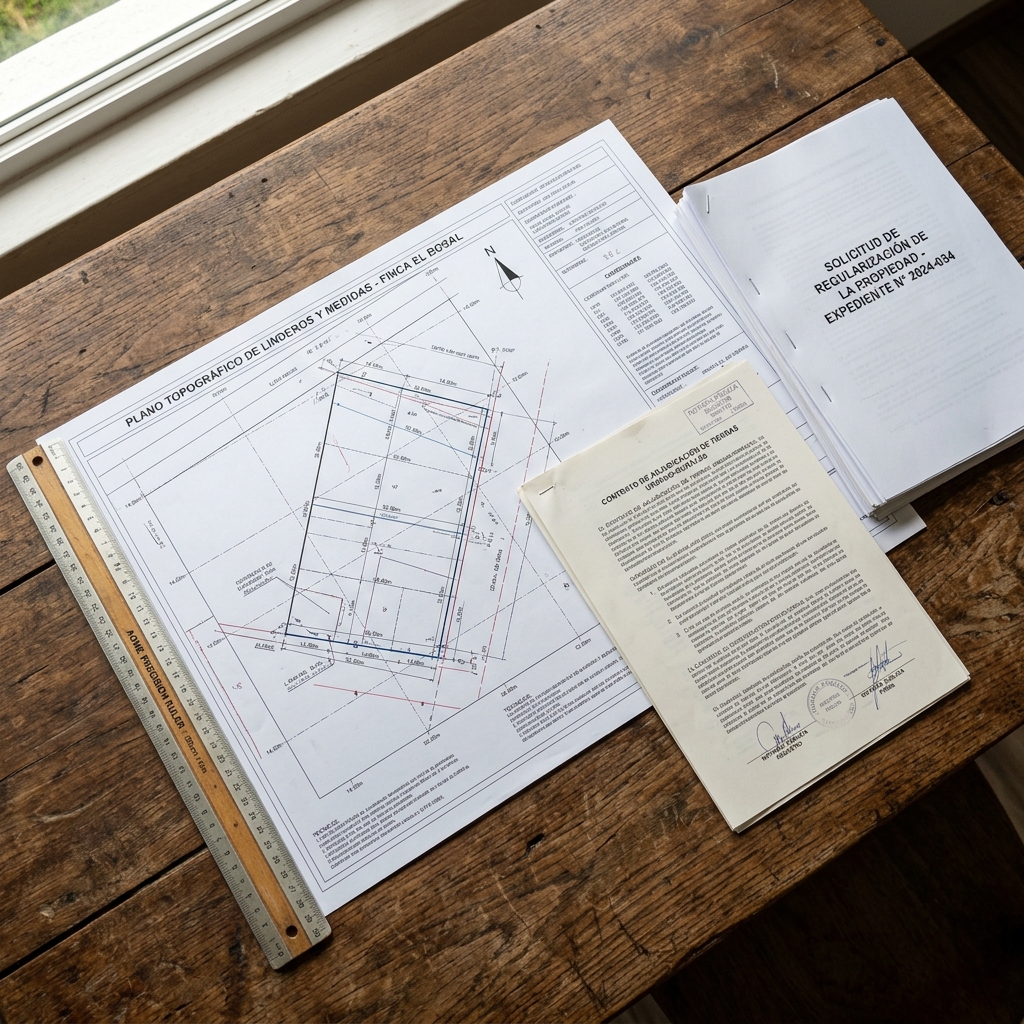
Before discussing the subsidy, it is essential to understand the process. Regularization (saneamiento), governed by Decree Law 2.695, is an exceptional mechanism of the Chilean State designed to solve the irregularity of small real estate. It allows those who have materially possessed a piece of land for at least 5 years, without violence or clandestinity issues, but who lack legal deeds or "clean papers", to obtain a valid title deed.
The importance of this title regularization lies in the fact that, without it, you cannot formally sell, mortgage, inherit, or apply for housing subsidies from MINVU or INDAP for your property.
Is there any subsidy to regularize a piece of land?
Yes. The complete rural and urban land regularization process involves significant expenses: topographical surveying, publications in the Official Gazette, official letters, and registrations at the Real Estate Conservator. To support lower-income families, the Ministry of Bienes Nacionales has a subsidy system that fully or partially finances these operational costs.
It is vital to be clear on this point: this subsidy is requested and granted solely and exclusively by Bienes Nacionales, never through private offices. Any private entity that promises to "get you the subsidy" in exchange for money or that charges to manage it independently, is not telling the truth.
Benefit tiers according to the Social Household Registry
The level of state funding is not universal; it is assigned progressively according to the vulnerability of the applying family, measured through the Social Household Registry (RSH) form:
- Total gratuity: The most vulnerable tiers (generally the 40% most vulnerable) can access 100% funding of the operational process cost.
- Co-payment or partial gratuity: Middle tiers receive decreasing coverage percentages (e.g., 75% or 50% subsidies), requiring the beneficiary to pay the difference or "co-payment".
- No state benefit: Higher-income tiers (usually over 80% or 90%) must bear 100% of the Ministry's operational costs.
[Note: We recommend confirming the exact coverage percentages currently in effect directly with your regional SEREMI, as they may undergo annual budget adjustments.]
How to apply for free or subsidized regularization
The process to activate this benefit is carried out simultaneously with the title application.
Step by Step: Applying for the Bienes Nacionales Subsidy
Step 1: Check your Registry. Before any management, verify your socioeconomic qualification by logging in with Clave Única to the Social Household Registry portal. This is the basis of your evaluation.
Step 2: Gather background information. You must collect appraisal certificates, proof of property tax payments (or exemption), residency certificates, utility bills in your name, and any document proving you have inhabited the place for more than 5 years.
Step 3: Formal presentation. The submission of the official application at Bienes Nacionales is done in person at the Regional Ministerial Secretariat (SEREMI) of your region, or its provincial offices.
Step 4: Ministerial Evaluation. Bienes Nacionales will cross-check your data, determine if your case is legally viable (there must be no pending lawsuits and it must not exceed the maximum appraisal), and evaluate your socioeconomic tier to inform you if you will access gratuity or how much your eventual co-payment will be.
Substantive requirements that the subsidy DOES NOT replace
A common mistake is to confuse the subsidy (funding) with the right to regularize. Being in the 40% most vulnerable tier does not automatically grant you a title deed if you do not strictly comply with the legal requirements of DL 2.695. The State does not give away land; the State formalizes those who are already legitimate de facto possessors.
| Excluding Requirement | Legal Description |
|---|---|
| Material Possession | It must be continuous, exclusive, and without violence for a minimum of 5 years. |
| Absence of Lawsuit | There must be no pending ownership or demarcation lawsuit over the property. |
| Fiscal Appraisal Limit | Less than 800 UTM (urban) or 380 UTM (rural). |
| Clear Physical Boundaries | The land must be bounded by fences, walls, or other verifiable landmarks. |
Realistic timelines and expectations
If you decide to opt for the administrative route directly at the state offices, you must have very clear time expectations. Due to the very high caseload and the fact that state resources (surveyors, reviewing lawyers) must be distributed equitably throughout the region, a regular regularization usually takes between 2 and 4 years.
It is a long-term process that advances at the pace of public administration. If you have the ability to wait patiently, the state route is your smartest choice.
When the state route is advisable and when private advice is better
Our recommendation at Terreno en Regla is transparent: if you qualify for total gratuity or a high subsidy, your case is simple, there are no conflicting neighbors, and you have no time urgency, always use the State's free route. You don't need to pay a private lawyer to deliver the same papers you can drop off at the SEREMI's parts office.
However, there are critical scenarios where processing on your own or waiting for fiscal deadlines can cost you the property or years of litigation. We suggest evaluating our obtaining property title services when you face:
- Previous title problems: If there was a badly executed sale, broken purchase promises, or overlapping registrations (cases that the Supreme Court strictly monitors).
- Unprocessed inheritances: Attempting to regularize land that belonged to grandparents without processing the other heirs usually ends in legal opposition that blocks the process.
- Third-party oppositions or conflicting boundaries: If you have neighbors who have moved fences, or if a forestry company claims your plot, your fiscal file will be frozen as soon as there is opposition.
- Rejected files: If you have already submitted the papers to Bienes Nacionales and the resolution was negative, you need legal strategy to rebuild the case, not simply resubmitting the folder.
- Commercial urgency: If you need the title to sell, apply for a mortgage loan, or apply for housing subsidies within this same year.
Doubts about your case?
If your situation is complex or a previous application has already been rejected, we can perform a preliminary legal evaluation to determine the true viability of your regularization.
Check if I qualify via WhatsAppFrequently Asked Questions
Is the regularization at Bienes Nacionales free?
It is not always free. The Ministry of Bienes Nacionales offers subsidies that can cover 100% of the cost for the most vulnerable families, or a partial percentage (co-payment) for middle tiers. It depends exclusively on your qualification in the Social Household Registry (Registro Social de Hogares).
How do I know which tier of the Social Household Registry I am in?
You can check it directly by logging in with your Clave Única to the official portal of the Social Household Registry (registrosocial.gob.cl). There, your current socioeconomic qualification percentage will appear, which will be reviewed by Bienes Nacionales when you apply.
Can I apply if the land belonged to my deceased parents?
Yes, but it requires care. Decree Law 2.695 requires the applicant to be the current material possessor. However, if there are legal heirs with a better right, they could oppose the regularization. The safest approach in cases of death is to process the effective possession first.
How long does the subsidized regularization route take?
Regularization through the state route usually takes between 2 and 4 years. This extended timeframe is due to the high demand for subsidized applications and the exhaustive review that public agencies must carry out at each stage.
What happens if someone opposes my application?
If a third party who believes they are the owner or another heir submits a formal opposition, the Ministry of Bienes Nacionales will suspend the administrative process and refer the case to the courts of justice, paralyzing the obtaining of the title until a judge resolves.
Disclaimer: The information contained in this article is for guidance and informational purposes. State benefits, deadlines, subsidy percentages, and procedures depend entirely on current legislation and the policies of the Ministry of Bienes Nacionales, which are subject to modifications without prior notice. Terreno en Regla is a private law firm and is not part of said Ministry or any state agency. We recommend verifying your qualification and current requirements directly on official State channels before starting your process.